Saint of the day
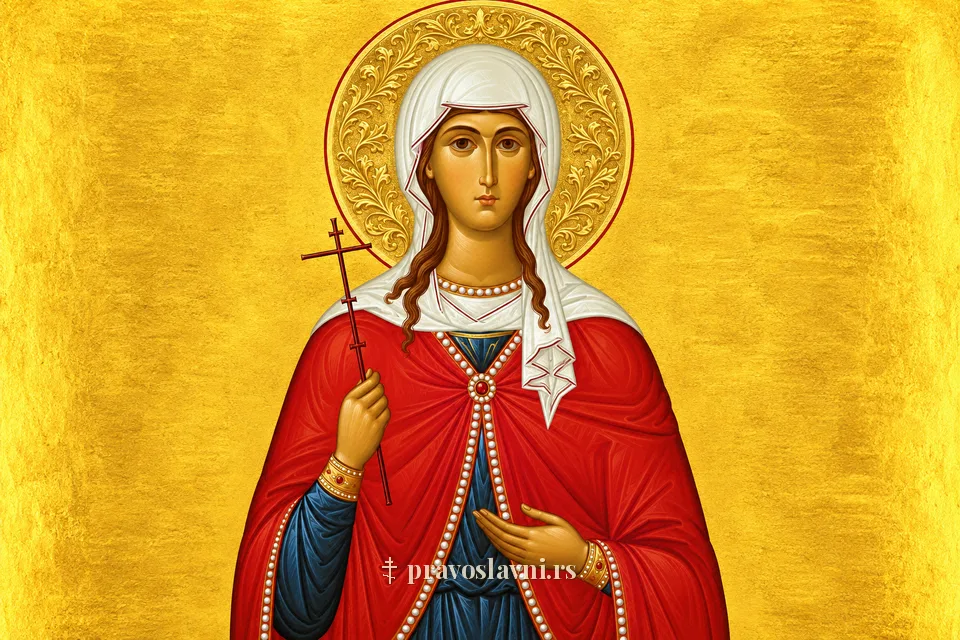
Holy Martyr Tatiana
What happenedThe Roman deaconess Tatiana brought her torturers to Christ by her prayer, and God kept and healed her through every suffering.
Read the LifeOrthodox Calendar · 12 January according to the Julian calendar
Monday, 25 January 202712 January (according to the Julian calendar)What happenedThe Roman deaconess Tatiana brought her torturers to Christ by her prayer, and God kept and healed her through every suffering.
Read the Life
You may eat meat, eggs, milk and dairy products, as well as any other food — but try to be moderate.
More about the fast →
Today the Church keeps the commemoration of a saint · not a Red Letter day.
More about the feast →
“Yet in all these things we are more than conquerors through Him who loved us.”
— Rom 8:37Tatiana came from a very distinguished Roman family. Her Life says that her father, although he held a high office of state, was secretly a Christian and that he brought her up in the faith and in Holy Scripture. She renounced marriage, lived in fasting and prayer, and the Church of Rome appointed her a deaconess.
She suffered in the time of the Emperor Alexander, a young man of wavering faith, under whom Christians were persecuted by powerful officials of the state. They demanded of Tatiana, as of the other Christians, that she bow down to the Roman gods. Her Life tells of three temples to which they took her: the temple of Apollo was shaken by an earthquake, the temple of Diana became a burnt-out ruin, and the statue of Zeus was found in fragments.
The Prologue describes her suffering as an alternation of tortures and prison that lasted for days. Yet her wounds healed overnight, and both sources ascribe this to angels sent by God. According to her Life, invisible angels punished her torturers, so that they themselves begged the judge to stop. She did not wish them evil, but prayed that they might come to know the truth. Then they became aware of the angels beside her and, according to her Life, asked her forgiveness. Eight of them became Christians, and afterwards martyrs as well.
Not even the lion before which they cast her did her any harm. The pagans believed that some sorcery in her hair was giving her strength, and so they cut it off, but that did not help either. At last the judge, powerless to break her, passed sentence that she should be beheaded with the sword. Together with her they also put to death her father, who had been stripped of his rank and property when it became known that he was a Christian. According to the Prologue this took place around the year 225, and according to her Life around 226.
According to the Prologue, this frail woman had the courage of a soldier. Her example teaches that faithfulness to Christ overcomes both tortures and idols, and that prayer for one's enemies can bring them too to the faith. It was not sorcery that kept her, but the power of God. Her Life ends with glory to Christ, Who crowned both her and her father with the crown of martyrdom.
Tatiana's home was among the most distinguished in Rome. Of her father the Life says two things which at first sight are hard to reconcile: three times he held high office in the state, and in secret he served Christ. This man brought up his daughter in the faith and himself introduced her to Holy Scripture.
Marriage was out of the question for Tatiana. She chose virginity and entrusted her whole life to Christ, and fasting and prayer were her daily life. Because of the way she lived, the Church of Rome appointed her a deaconess.
After the violent death of Heliogabalus the throne passed to Alexander, who, according to the Life, was only sixteen years old. The Christian in the family was his mother Mamaea; her son inherited from her only a part of the faith, and so at court, according to both sources, a statue of Christ stood beside those of others. He himself did not persecute Christians. The Life says that the real power, instead of the under-age ruler, was held by the senators, led by Ulpian, who hated Christians; from that circle there went out through the empire an order that sacrifice to the Roman gods should be extorted from Christians by force.
The Life mentions three temples to which Tatiana was taken to bow down to the idols, and not one of them remained the same afterwards. For the temple of Apollo the Life records an earthquake after her prayer to Christ; in it, together with many pagans and pagan priests, the idol itself perished too. She agreed to go to the temple of Diana only in appearance, when the judges tried to win her over with fair words. While she was still approaching, from the statue of the goddess, according to the Life, there was heard the cry of a demon: “Woe is me, woe is me! Where shall I flee from Your Spirit, O God of heaven?” That temple did not survive her prayer and the sign of the Cross either: according to the Life, it was burned up by fire from heaven, and with it the pagan priests and a great many people perished. At last they locked her for two days in the temple of Zeus. According to the Life, on the third day the statue of Zeus was found in fragments, and Tatiana full of joy.
Between those events Tatiana was tortured. The torturers, according to the Life, themselves received blows from angels whom they did not see. She did not seek revenge, but prayed that these people might come to know the truth. The Prologue and the Life bear witness that the prayer was heard: the torturers became aware of four angels who were surrounding her. The Life ascribes these words to them: “Forgive us, servant of the true God, forgive us, for what we did to you was not of our own will.” Eight of them received faith in Christ and laid down their lives for that faith.
The Prologue presents her suffering as a succession of days in which tortures and prison alternated. That after all this she still remained alive and well, the Prologue and the Life explain by the same reason — the angels of God, from whom she received comfort and healing in prison. The lion before which they threw her remained gentle, and the Life adds that fire did not burn her either.
Seeing that nothing was of any use, the judge pronounced the sentence of death by the sword. The sword did not spare her father either. His secret faith came to light, and he, stripped of everything he had, was executed together with his daughter. According to the Prologue this was around the year 225, and according to the Life around the year 226.
The Prologue praises her because, although a frail woman, she showed the courage of a soldier in the contest. The pagans, as both sources record, even cut off her hair, for they were looking in it for the secret of her endurance. It was not her hair that guarded her, however, but the power of God, and her prayer for her enemies opened for the torturers the way to the truth. The Life ends by glorifying Christ, Who crowned both daughter and father with the crown of martyrdom.
The “Milk-giver” icon of the Theotokos and the staff of St Sabbas the Sanctified were for a long time kept together, in the monastery of that saint near Jerusalem. According to both sources, these two heirlooms had an owner appointed in advance: some eight centuries earlier Sabbas the Sanctified, by his prophecy, intended them for a Serbian priest who would bear his name. The promised guest appeared in the person of St Sava of Serbia: the monks recognised in his visit the fulfilment of the old prophecy, and both heirlooms passed to him. In this way the icon came to the Holy Mountain, to St Sava's hermitage (Posnica) in Karyes, and was given its place to the right of the royal doors. For the staff another cell in Karyes was chosen, the Paterica. The sources say nothing about the appearance of the icon, about where its name comes from, or about miracles. Even so, this icon forms a living bond between the Serbian Church and the monastic heritage of Jerusalem.


