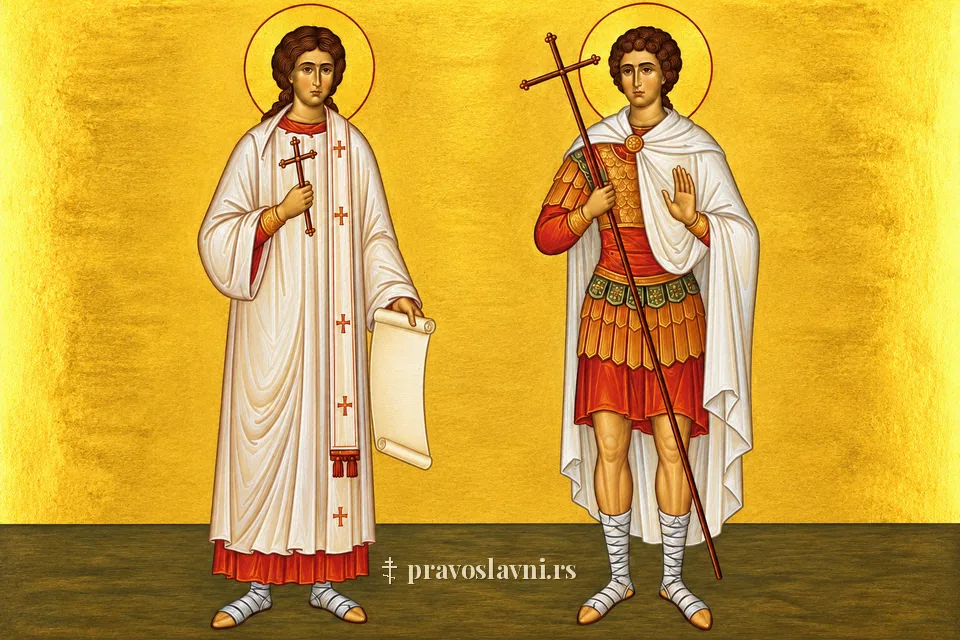
Saints of the day
Holy Martyrs Hermylus and Stratonicus
What happenedThe deacon Hermylus and his jailer Stratonicus, bound together in the same net, were thrown into the Danube, because neither would deny Christ.
Read the LifeOrthodox Calendar · 13 January according to the Julian calendar
Tuesday, 26 January 202713 January (according to the Julian calendar)What happenedThe deacon Hermylus and his jailer Stratonicus, bound together in the same net, were thrown into the Danube, because neither would deny Christ.
Read the Life
You may eat meat, eggs, milk and dairy products, as well as any other food — but try to be moderate.
More about the fast →
Today the Church keeps the commemoration of a saint · not a Red Letter day.
More about the feast →
“Blessed are those who are persecuted for righteousness’ sake, For theirs is the kingdom of heaven.”
— Mt 5:10The deacon Hermylus suffered in the persecution that was set in motion by the Emperor Licinius. A certain soldier denounced him, accusing him of mocking the gods and the emperor. When they came for him, they found him at prayer, and, according to both sources, he set off to the court cheerfully. He did not hide from the emperor that he was a Christian. His Life records that he refused to acknowledge any divinity in the idols. Against the emperor's threats he armed himself with a verse from Psalm 117: when the Lord is one's helper, man can do nothing to him.
There followed torture, then prison, then torture again. According to his Life, the blows of the iron rods caused him no pain. In the prison an angel visited him with the words: “Hermylus, do not be afraid! Speak, and do not keep silent!” He promised him victory and a crown. A voice from heaven also announced to him that his torments would quickly pass. One day, according to his Life, he came out before the emperor serene and declared: “The dark prison has obtained for me a great light.”
The gaoler Stratonicus secretly believed in Christ. The endurance of Hermylus moved him so deeply that, in the end, his weeping gave him away. When they brought him before Licinius, he denied neither his faith nor his friendship with Hermylus. Then they beat him too and shut him up together with Hermylus. His Life records that in the prison he prayed for the forgiveness of his former sins.
Hermylus was condemned to death in the Danube. Stratonicus too could have saved himself by a sacrifice to the idols. According to his Life, he refused: he did not wish to outlive his friend, and he was glad to die for Christ. They went to the place of execution singing glory to God. Both of them were thrown into the Danube, but the river did not keep their bodies, and Christians buried them not far from Belgrade. They suffered in the year 315.
Their Life records that they were buried in the same grave, as a sign that they had shared everything to the end. Their story teaches that God strengthens the one who bravely confesses the faith. It also teaches what friendship in Christ means: a gaoler became the brother of his prisoner, in life and in death.
Eighteen stadia from Belgrade, according to the Life, two martyrs were laid in the same grave. Before the Christians buried them there, the Danube, after they had been thrown into it, carried their bodies until the third day. One was the deacon Hermylus, and the other Stratonicus, the man who guarded him in prison. Both suffered in the year 315, in the persecution that the Emperor Licinius set in motion in order to win the favour of his gods.
The Life describes that persecution as a hunt which passed by neither towns nor villages, in which informers made money out of the Christians. Hermylus was denounced by a certain soldier, who accused him of mocking the gods and the Emperor. The Emperor's men found him at prayer, and both sources stress with what joy he set out to stand before the court.
The Emperor heard from him a clear confession: he is a Christian and a deacon of the God Whom eyes do not see. Licinius' proposal that he should extend his ministry to the Emperor's gods as well Hermylus refused: for him the idols were not gods, but manufactured things. Nor did threats shake him: he answered with a verse from Psalm 117, that he is not afraid, for the Lord is his helper, and so what can man do to him. The blows with iron rods, according to the Life, caused him no pain; instead of begging for mercy, he spoke to the Emperor about the judgement that awaited the Emperor himself.
The Life says a great deal about what was happening in the prison to which Hermylus was returned between the tortures. The psalms did not leave him either on the road or in the prison. There an angel visited him and said to him: “Hermylus, do not be afraid! Speak, and do not keep silent!”, with the promise of victory and a crown. Later, while they were beating him again, Hermylus prayed that he might share the sufferings of Christ, remembering His trial before Pontius Pilate. The answer, according to the Life, did not fail to come: a voice was heard from heaven which confirmed his prayer and told him that the tortures would leave him in three days. That voice knocked the executioners off their feet. Hermylus ended up in prison once more, by order of an emperor whose eyes not even his own fear had opened to God.
The Life also records the night in which a heavenly light illumined the prison while Hermylus was singing a psalm. The next day he stood serene before the Emperor and uttered the sentence that the Life remembers: “For me the dark prison has obtained a great light.” The tortures went on, and he withstood them with verses from the psalms.
All this was watched by Stratonicus, the gaoler who was hiding his faith in Christ. According to the Life, sorrow and admiration were mingled in him. Yet at that hour he was still not ready to stand before the torturers himself as well. At last he could no longer conceal his weeping, and that was enough for those present to denounce him to the Emperor. Before Licinius he did not even try to extricate himself: he confessed Christ, said that he was Hermylus' friend, and spoke of the idols with mockery. For that he too was given a beating. The Life says that, while they were beating him, he begged Hermylus to pray for his steadfastness, and told the Emperor to fear the true God.
The night before the end they spent in the same prison. Stratonicus, according to the Life, prayed for the forgiveness of the sins of his earlier life. The Life says that on that very night an answer came to them from heaven: the following day would be the day of their reward.
Hermylus was sentenced to be drowned in the Danube. Stratonicus too was left the possibility of saving his life by a sacrifice to the idols. He refused, according to the Life, as a friend: without Hermylus life meant nothing to him, for friends share both sorrow and joy, and to die for Christ was the dearest thing of all to him. And so they sentenced him to the river as well. They made their way to the river with a hymn of praise to God, and the end came in the Danube, where they were thrown tied up in a single net.
For the writer of the Life the shared grave is no accident: these two went together in everything, and so the earth too received them together. Their story bears witness that God strengthens the one who confesses Him bravely. And the gaoler who watched the courage of his prisoner and set out along his path shows what friendship in Christ means.


