Saint of the day
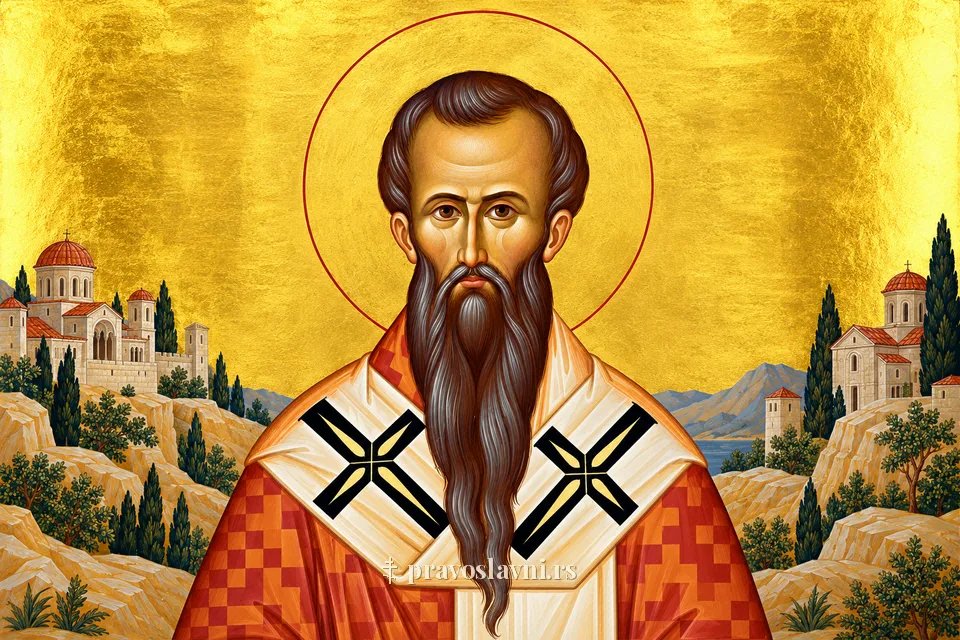
St Meletius, Archbishop of Antioch
What happenedWhen a heretical deacon covered his mouth with his hand, Meletius raised three fingers, then one, and so confessed the faith in the Holy Trinity without words.
Read the LifeOrthodox Calendar · 12 February according to the Julian calendar
Thursday, 25 February 202712 February (according to the Julian calendar)What happenedWhen a heretical deacon covered his mouth with his hand, Meletius raised three fingers, then one, and so confessed the faith in the Holy Trinity without words.
Read the Life
You may eat meat, eggs, milk and dairy products, as well as any other food — but try to be moderate.
More about the fast →
Today the Church keeps the commemoration of a saint · not a Red Letter day.
More about the feast →
“The grace of the Lord Jesus Christ, and the love of God, and the communion of the Holy Spirit be with you all. Amen.”
— 2 Cor 13:13Among the disciples of St Meletius, Archbishop of Antioch, his Life names John Chrysostom, Flavian and Diodore of Tarsus. It was he, as the Prologue and the Life record, who baptised Chrysostom, and the Life adds that Chrysostom later wrote a eulogy in his honour.
Meletius died in Constantinople, in the first days of the Second Ecumenical Council, in which, according to the Prologue, he took part. Theodosius, as Emperor, held him in special honour, and Meletius installed Gregory the Theologian on the see of Constantinople. The Life says that all the Orthodox people wept for him. Antioch, his own see, later received his relics.
The Prologue also remembers a miracle from that council: while he was explaining the Holy Trinity to the Arians, his hand shone with light. With the same sign of his fingers he had confessed the faith at the beginning of his ministry in Antioch as well. Before that he had been, according to the Life, Bishop of Sebaste in Armenia and of Beroea in Syria. The Arians, according to whose teaching Christ is not true God, supported his election, according to the Life, believing that he thought as they did. But in his very first sermon he confessed the Holy Trinity. When a certain deacon, according to the Prologue and the Life, tried to silence him by covering his mouth, Meletius completed his confession without a voice, by the movement of his fingers.
Because of this, exile awaited him, and that, according to both sources, three times; the Life says that he was banished by the Emperors Constantius, Julian the Apostate and Valens. He returned for the last time when Theodosius brought back the Orthodox bishops.
In divided Antioch he did not reject Paulinus, the leader of the other Orthodox party. The Life says that he offered to share the flock with him, with the Gospel on the throne between them, until one of the two of them should die. Paulinus refused that proposal. Epiphanius testified that the people loved Meletius very much. To the ascetic Simeon, the future stylite, who at that time wore iron fetters, he sent word, according to the Life: “A man can master himself even without fetters.”
His life shows that truth and meekness go together: he remained unshakeable in the faith, yet always ready for peace.
St Meletius lived at a time when the Church was being torn apart by the Arian heresy, a teaching which denied that the Son of God is God. The Prologue remembers him as a man who fought against that error all his life. Antioch, according to his Life, was preceded by his episcopate in two dioceses — Sebaste in Armenia and Beroea in Syria.
His Life records that in the year 360 a council in Antioch elected Meletius and that he ascended the throne with the consent of Emperor Constantius. The numerous and powerful Arian bishops supported him, because they believed that he thought as they did. His Life relies on Theodoret when it tells how many people came out to meet him: the clergy, the dignitaries, the citizens in great numbers, and even Jews and pagans.
The very first sermon showed who the new archbishop was. Meletius openly preached the Nicene faith and the Holy Trinity. A certain heretical deacon — his Life says an archdeacon — wanted, according to the Prologue and his Life, to silence him by closing his mouth with his hand. Yet Meletius did not fall silent — he completed the confession of faith in one God in Trinity with a movement of his fingers. According to his Life, when the archdeacon then held back his hand, the saint spoke, and in this way he several times replaced the word with the sign.
According to his Life, some thirty days after his arrival the heretics drove him out of the church, the Arians declared him a Sabellian, and Emperor Constantius exiled him by night to Armenia. In his place the Arian deacon Euzoius was installed.
Three exiles, which both the Prologue and his Life mention, marked his episcopate. According to his Life, under Julian the exiled bishops were at first released, and so he too returned. But Julian renounced the faith, began to persecute the Christians and exiled him again; his Life records that in that persecution the priests Eugenius and Macarius and the commander Artemius suffered. The devout Emperor Jovian brought Meletius back, according to his Life in the year 363, and in the same year, at a council in Antioch, the Arians confessed the Nicene faith, that the Son is of one essence with the Father. His Life says that Emperor Valens, under the influence of his wife Domnica, gave Antioch back to the Arians, and Meletius went into exile for the third time, where he remained until the death of Valens in the year 378. He returned only when Emperor Theodosius brought back the Orthodox bishops.
Meletius was not only a fighter, but also a peacemaker. The Orthodox in Antioch were divided into the Paulinians, around Paulinus, and the Meletians. His Life says that he recognised Paulinus as a bishop, and he himself received into his flock the Arians who were returning to Orthodoxy, whom the Paulinians did not want. To Paulinus he offered a solution without a victor: that they should lead the flock together, with the Gospel as mediator, until the death of one should leave the whole flock to the other. Paulinus refused this. The matter, according to his Life, was settled by the Emperor: the cathedral and the other churches went to Meletius, while Paulinus remained at the head of his own faithful. His contemporary Epiphanius praised his blameless life and said that the people loved him greatly.
Around him there grew up a generation of holy men. From his school, according to his Life, came John Chrysostom and his friend and peer Basil, Diodore of Tarsus, Elpidius, Bishop of Laodicea, Acacius, who would later govern Beroea, and Flavian, his successor on the see of Antioch. The Prologue and his Life say that he baptised John Chrysostom. His Life adds that he later also ordained him a deacon, while the Prologue names Basil the Great as the deacon whom Meletius ordained. To the young ascetic Symeon, who would later become a stylite, and who at that time was keeping himself in iron chains on a high mountain, Meletius, according to his Life, sent word: “A man can rule himself even without chains.”
The Second Ecumenical Council in Constantinople, held according to his Life in the year 381, was his last field of battle: the Prologue says that he took part in it, his Life that he presided over it, and the Emperor honoured him especially. Emperor Theodosius, according to his Life, recognised him at the council at first glance, because before coming to the throne he had dreamed that Meletius was crowning him. At the council he once more explained the Trinity to the Arians with that same sign of the fingers. Both sources record the miracle which followed then, but they describe it differently: according to his Life fire came forth from Meletius, and according to the Prologue his hand shone. Then, as his Life records, he said: “So then, we understand three Hypostases, and we speak of one essence.” It was he who installed Gregory the Theologian on the see of Constantinople.
He reposed in Constantinople a few days after the beginning of the council, before all the bishops had arrived. According to his Life, everyone mourned him — the Emperor, the fathers of the council and the Orthodox people — and buried him with solemnity. Antioch later received his relics, which, according to his Life, rested beside the relics of St Babylas.
St Meletius teaches us that the faith is confessed even when they close our mouths. Three times exiled, he sought peace among the brethren and brought up saints. Firmness in the truth and meekness towards people — that is his legacy.


