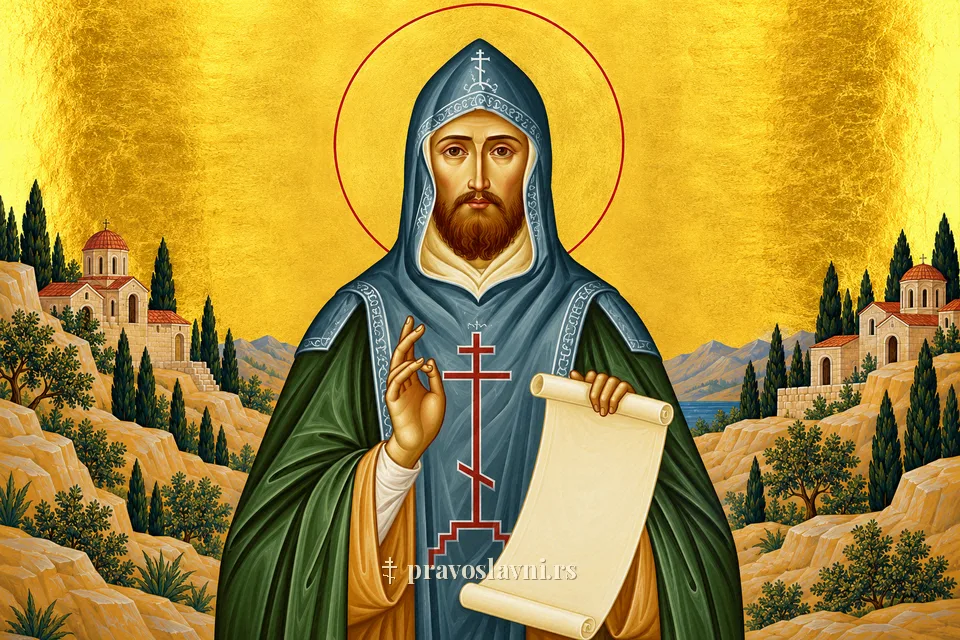
St Cyril, named Constantine at his baptism, gave the Slavs their letters: the Prologue and his Life say that he composed the alphabet, of thirty-eight characters, on his return to Constantinople, and after the letters came the first translations of the service books from Greek.
He was born in the distinguished Thessalonian house of Leo and Maria. The Life says that as a boy he dreamed that he was choosing Sophia, Wisdom, as his bride. At the imperial court, where he studied alongside the young Emperor Michael, he mastered grammar, philosophy and many other sciences, spoke several languages, among them Latin and Syriac, and was given the name the Philosopher. He refused the marriage and the honours that were offered to him, because learning was worth more to him, and he served as a priest and librarian at Hagia Sophia.
He put his knowledge at the service of the faith. According to the Life, he overcame the deposed iconoclast Patriarch John in debate, and to the Saracens in Samarra he explained the mystery of the Holy Trinity by the example of the sun. To the Khazars, who were asking for a teacher, he went with Methodius: while his brother prayed, he debated with Jews and Saracens at the khagan's court, and the khagan and many with him received baptism. The khagan, according to the Life, wrote to the Emperor that anyone who wishes is free to be baptised. In Cherson, as the Life says, he took part in the finding of the relics of St Clement, Pope of Rome, and instead of gifts the brothers asked for freedom for the Greek captives.
The Moravian priests received from the brothers books for the instruction of the young when Prince Rastislav invited Cyril and Methodius to his land, and the faith was made firm there. The journey to Rome, to which the Pope had called him, was his last: according to the Prologue and the Life, he died there of illness on 14 February in the year 869. Methodius continued the work in Moravia, and his disciples carried it across the Danube, to Ohrid.
By his life St Cyril shows that learning has its greatest worth when it serves the faith and the people: he gave up honours, and gave the people books in their own language.
Full Life
An Alphabet for a Whole People
The Slavs remember St Cyril, named Constantine at his baptism, above all for the alphabet. The Prologue and his Life say that, when he came back to Constantinople from the mission to the Khazars, he gave the Slavic language an alphabet — thirty-eight characters — and after the alphabet came the first translations of the service books as well. In Moravia, where Prince Rastislav invited the brothers, the priests received from them copies of the books from which they were to teach the young, and the people received strengthening in the faith. Constantine travelled for the last time to Rome, at the Pope's invitation; there illness overtook him, and there, as the Prologue and his Life record, he died on 14 February 869.
His brother Methodius worked in Moravia until the end of his life. Ohrid in Macedonia then became the new centre of their work: from there the mission was continued by the disciples of Methodius, known as the Five Disciples, together with Bishop Clement.
The Boy Who Chose Wisdom
The household of Leo and Maria in Thessalonica was respected and well-to-do; his Life says that the father held the rank of centurion. He lived in the time of the iconoclast emperors — Leo the Armenian, Michael the Stammerer and Theophilus. His Life remembers several signs from his childhood. As a seven-year-old he dreamed that he was choosing a bride and that he chose the maiden Sophia, that is, Wisdom, and his parents understood the dream as a sign. He turned even a boyhood loss — a hawk that vanished in the wind — into a decision: after two days without food he turned his back on worldly vanity. He chose Gregory the Theologian as his teacher: he learned his writings by heart and, with a prayer written on the wall, he asked for his help.
It was the elder brother who learned the Slavic language: Methodius served for ten years as a military commander among the Slavs — according to the Life in Sclavinia, according to the Prologue among the Macedonian Slavs — and then he became a monk on Olympus.
Learning above Honours
At the court, where after the death of Theophilus the Logothete of the Drome, a friend of the family, brought him to study alongside the young Emperor Michael, Constantine mastered many branches of learning — those of language, mathematics and philosophy, and music and astronomy as well — and among his teachers were Leo and Photius. He spoke several languages, among them Latin and Syriac, and he was given the nickname the Philosopher. When the Logothete offered him his own spiritual daughter as a wife, and with her honours and a military command, he refused, because learning, as he said, was worth more to him. As a priest he was given the post of librarian at Hagia Sophia, but, according to his Life, he went away in secret to a monastery on the Golden Horn; only half a year later was it discovered where he had taken refuge, and then he agreed to teach philosophy in the chief school of the capital.
Defender of the Faith
He placed his learning in the service of the faith. According to his Life, in a debate he silenced the deposed iconoclast Patriarch John. At the age of twenty-four, with two scribes, he was sent to Samarra, among the Saracens, who mocked the Holy Trinity. He explained the mystery of the Trinity to them by the example of the sun, and he also defended the birth from the Virgin and the Christian law. His Life says that they tried to poison him, but the poison did him no harm, and he returned, seen off with honours. For some time after that he lived in solitude, without any store of food at all, leaving the next day to God and giving whatever was left over to the poor, until he joined Methodius on Olympus.
When the Khazars asked for a teacher who would answer the Jews and the Saracens, Emperor Michael, on the advice of Patriarch Ignatius, sent the brothers. At the court of the khagan Constantine held debates with the Jews, the Saracens and the Khazars, and during that time Methodius prayed. Baptism was received by the khagan, by many nobles and by the people — his Life mentions two hundred Khazars — and the khagan wrote to the Emperor that he gave thanks and that anyone who wished was free to be baptised. The brothers did not want gifts; they asked only that the Greek captives be released, and about two hundred of them were given their freedom.
Signs along the Way
His Life also records miracles from that journey. The Ugrians who attacked them bowed down after Constantine's prayer. In Cherson, where they stayed for a long time, he learned Hebrew and translated eight parts of the Hebrew grammar, and he also came upon a Gospel and a Psalter written, as his Life says, in Russian letters, as well as a man who spoke that language; he mastered the language by dividing the letters into vowels and consonants. There, with Bishop George and the clergy, he took part in the finding of the relics of St Clement, Pope of Rome, which, according to his Life, came out of the sea at midnight, accompanied by light; the brothers later carried a part of those relics to Rome. He foretold to Bishop George that he would die the next morning, and the bishop did indeed die in the morning. On the way back, according to his Life, at his prayer the bitter and salty water in a certain lake became sweet.
St Cyril, with his brother Methodius the Equal-to-the-Apostles teacher of the Slavs, reminds us that knowledge is most precious when it serves the faith. He gave up honours and marriage, defended Orthodoxy and gave the people books in their own language.
Other saints of the day
Venerable Auxentius
St Auxentius was a distinguished nobleman at the court of the Emperor Theodosius the Younger in Constantinople. His father, according to his Life, was the Persian Addas, and Auxentius himself was a learned man, skilled both in Holy Scripture and in philosophy. He was a friend of the monks Marcian and John, and then he himself became a monk and was ordained a deacon, and afterwards a priest. The praise of men troubled him, and so he chose solitude on a mountain near Chalcedon, which would later bear his name. The first to find out about him were shepherds; according to the Life, their lost flock returned at his prayer. After the shepherds, the sick soon began to arrive. The Prologue and his Life speak of the possessed whom he set free, of a paralysed man who stood up, of lepers cleansed with oil and of the blind who received their sight. And all the while he always said that it was the power of God that healed, and not he, and he called himself a sinner. When the Fourth Ecumenical Council assembled in Chalcedon, he was among those who defended Orthodoxy against the teaching of Eutyches and of Nestorius. The Life records that the Emperor Marcian honoured him greatly, but also that he endured insults from heretics. He founded monasteries and was the spiritual father of the whole of Bithynia. He reposed in great old age in the year 470.
Separate page: Venerable Auxentius →