Saint of the day
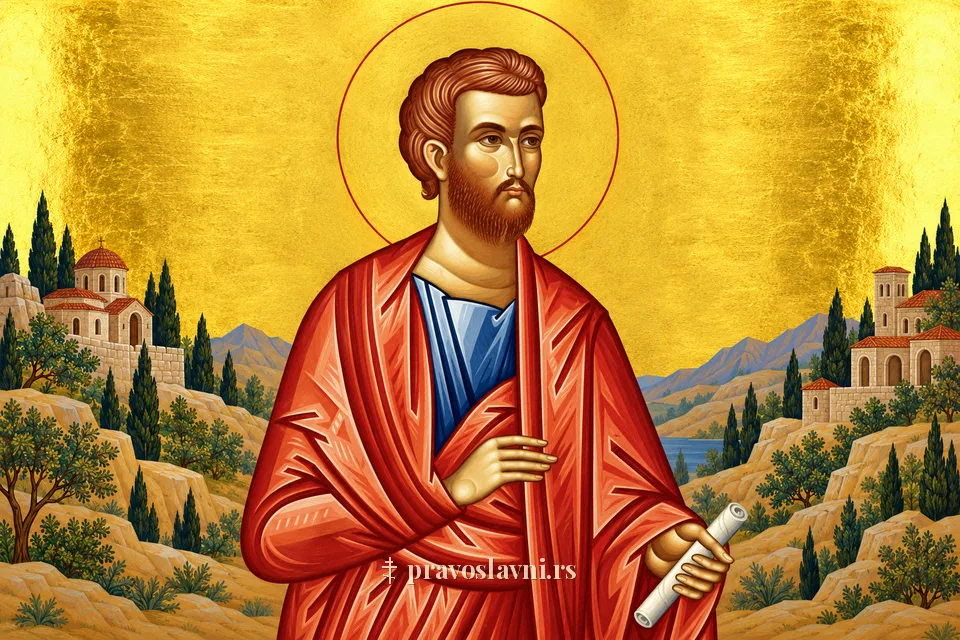
Holy Apostle Onesimus
What happenedThe runaway slave Onesimus received the faith from the Apostle Paul in Rome, became a bishop, and in the end a martyr for Christ.
Read the LifeOrthodox Calendar · 15 February according to the Julian calendar
Sunday, 28 February 202715 February (according to the Julian calendar)What happenedThe runaway slave Onesimus received the faith from the Apostle Paul in Rome, became a bishop, and in the end a martyr for Christ.
Read the Life
You may eat meat, eggs, milk and dairy products, as well as any other food — but try to be moderate.
More about the fast →
Today the Church keeps the commemoration of a saint · Sunday — a festive day · Sunday of the Prodigal Son (Lenten Triodion).
More about the feast →
“I appeal to you for my son Onesimus, whom I have begotten while in my chains, who once was unprofitable to you, but now is profitable to you and to me.”
— Philem 1:10–11“Your tortures cannot frighten me” — this, according to his Life, is how St Onesimus, by then an old man and Bishop of Ephesus, answered the Roman judge Tertullus. He confessed himself a Christian whom, a former slave, Christ had redeemed with His own blood, and idolatry, according to the Life, he called the root of sin, and he called the judge to repentance.
The slavery was not a figure of speech: Onesimus served Philemon in Colossae, in Phrygia, a man whom, according to the Prologue, Paul himself had brought to the faith. The Prologue numbers him among the Seventy Apostles. He wronged his master and fled to Rome, where the Apostle Paul, according to the Life then in chains, became his teacher and, as the Life says, baptised him. Onesimus then served the Apostle together with Tychicus, and with him, according to the Life, he also travelled to Colossae. Paul's letter to Philemon asked a brotherly welcome for the runaway; the Apostle called him his son, and the decision whether Onesimus would remain at his side he left to the master. The master forgave Onesimus and gave him his freedom.
He remained with the Apostles in Rome until the end of their lives, and from them he received the rank of bishop. Later he succeeded the Apostle Timothy on the see of Ephesus, and Ignatius the God-bearer mentions him in a letter as Bishop of Ephesus. The Life also mentions his preaching in Patras and Colossae, and on as far as Carpetania and Spain.
He was arrested in old age — the Prologue says in Trajan's persecution — and brought to Rome, for trial. Not even in the worst dungeon, in which he remained for eighteen days, did he keep silent, nor in Puteoli either, to which the judge, according to the Life, banished him. Because of that he was brought back before the court and beheaded. A silver coffin and an honourable burial were given to him, according to the Life, by a Christian woman of imperial family, who took his body; the Prologue records that this was in the year 109.
The path of Onesimus, from runaway to apostle and martyr, shows how much forgiveness can change a life: Philemon forgave, Onesimus found Christ, and God made a shepherd out of a slave.
The Apostle Paul wrote a separate letter to Philemon, a respected man from Colossae in Phrygia, and he wrote it on account of one single man — Onesimus, Philemon's slave. He asked the master to welcome the runaway as a beloved brother and not as a servant. The runaway, to whom he had given spiritual birth in prison, he called his son; he would gladly, he wrote, have kept him at his side, but he left the decision to Philemon. In this way the name of Onesimus is bound up with two epistles: with the one to Philemon, written for his sake, and with the Epistle to the Colossians, with which he was sent to the city of his master.
What came before that letter is told by the Prologue and his Life. Onesimus, whom the Prologue counts among the Seventy Apostles, served Philemon, a wealthy and respected man, whom, according to the Prologue, the Apostle Paul had earlier brought to the faith; his Life also calls Philemon an outstanding believer. Having wronged his master, the slave ran away; his Life says that he was afraid of punishment. The road brought him to Rome, to the Apostle, who at that time, according to his Life, was in chains. From Paul he received the faith and, as his Life says, baptism from his hands.
His Life also remembers Tychicus: alongside him Onesimus served the Apostle in Rome, and when Tychicus carried Paul's epistle to the Colossians, Onesimus set out with him. Philemon forgave the slave and gave him his freedom, and his Life adds that he sent him back to Rome, to serve Paul. Philemon himself, according to the Life, later became a bishop and is counted among the Seventy. A man who ran away from one master found another, Christ, and he served Him until death.
While the apostles were alive, Onesimus remained with them in Rome, and they ordained him a bishop. His Life carries his preaching far: as far as Patras, Colossae, Carpetania and Spain. The see of Ephesus came to him after the Apostle Timothy — his Life mentions John the Theologian before him as well. A letter of Ignatius the God-bearer bears witness to Onesimus as Bishop of Ephesus, and his Life tells that Ignatius, as he was being led to martyrdom, met Onesimus and the Christians of Ephesus in Smyrna, and that he praised him. So the former slave became a shepherd of the Church in Ephesus.
He was arrested as an old man — the Prologue says, in the persecution under Trajan — and brought to Rome. To the judge Tertullus he said, according to his Life, that he was a Christian and that Christ had redeemed him, a former slave, with His own blood. He called idolatry the root of sin, called on the judge to repent and said to him: “Your torments cannot frighten me.”
Not even in the worst of prisons, where he remained for eighteen days, did he keep silent: the faithful came to him and listened to his preaching. He preached in Puteoli as well, where Tertullus, according to his Life, had banished him, and because of that he was brought back to court. The torture, which his Life mentions, ended with beheading. A silver coffin and an honourable burial were provided for him by a woman whom the Prologue describes as rich, and his Life as a Christian of imperial family. The Prologue also gives the year of the burial: 109.
His Life draws a lesson from his life: leave vanity and sin, believe in the true God, love your neighbour and in persecution rely on the strength of Christ. And Philemon's forgiveness shows that forgiveness and reconciliation are possible: a runaway slave became an apostle and a bishop.
The Syrian hermit Eusebius, as the Prologue calls him, learned the monastic life from holy elders, and only then withdrew into solitude. He lived, according to his Life, on a mountain peak near Asicha, without any roof at all over his head. According to both sources he prayed without ceasing, and he did so out in the open, in all weathers. The Life also mentions clothing made of animal skin. About his food the sources do not say the same thing: according to the Prologue he ate only plants and did not taste even fruit, while the Life mentions soaked peas and beans. The Life records that he grew so thin that he had to sew his belt on to his clothing. From his many visitors he took refuge, according to the Life, by walling himself up in part of a nearby ascetic enclosure. He died peacefully in the year 440, at a great age: the Prologue reckons him at ninety-five years, while the Life says that he had passed his ninetieth. To the end he remained faithful to prayer and to the ascetic struggle.


