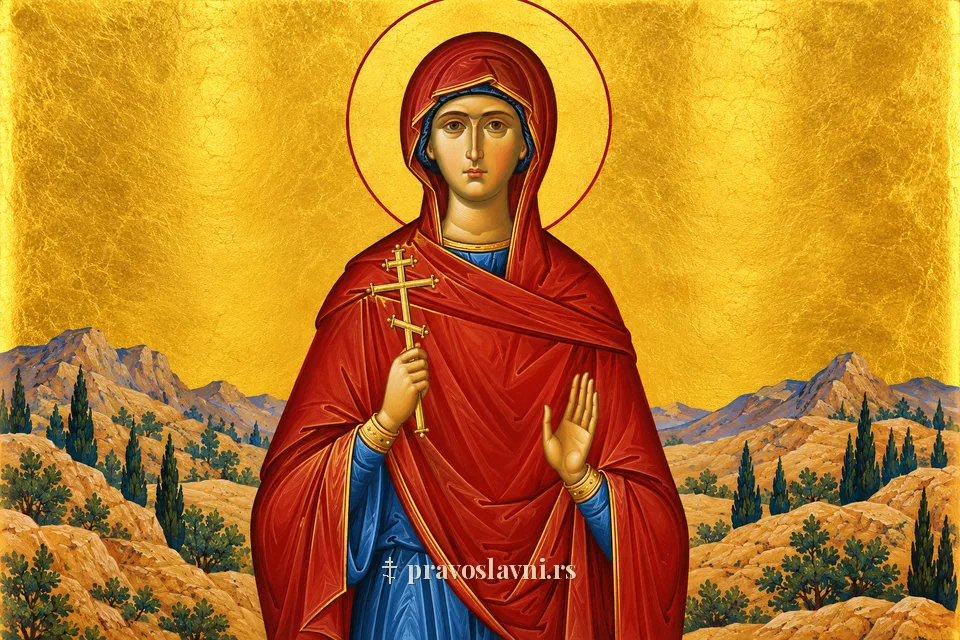
Saint of the day
Holy Martyr Agrippina
What happenedSt Agrippina, a virgin of Rome, suffered for Christ under Emperor Valerian, and her companions took her relics to Sicily.
Read the LifeOrthodox Calendar · 23 June according to the Julian calendar
Tuesday, 6 July 202723 June (according to the Julian calendar)What happenedSt Agrippina, a virgin of Rome, suffered for Christ under Emperor Valerian, and her companions took her relics to Sicily.
Read the Life
No meat, dairy products, eggs or fish — oil and wine are allowed.
This is a recommendation — for your own fast, consult your priest or spiritual father.More about the fast →
Today the Church keeps the commemoration of a saint · not a Red Letter day.
More about the feast →
“For I am persuaded that neither death nor life, nor angels nor principalities nor powers, nor things present nor things to come, nor height nor depth, nor any other created thing, shall be able to separate us from the love of God which is in Christ Jesus our Lord.”
— Rom 8:38–39Agrippina was from Rome, and her relics were translated to Sicily. In Rome this virgin, betrothed to Christ, suffered in the time of Emperor Valerian. Her relics were secretly taken by her companions, among them Bassa and Agathonica, and after a long voyage they buried them on the island. According to her Life, from the arrival of her relics the island was no longer under the power of demonic delusions, and her prayers were its protection. When the Hagarenes attacked the city in which she rested, they were forced to withdraw. The Life also mentions the sick who were healed, among them lepers, who came to her with faith; according to the Prologue, a church bearing her name was later built on the place where she was buried.
From childhood Agrippina lived in Rome according to the Gospel. She endured her torture with the help of an angel of God, who strengthened her, and in her torments she gave up her soul to God. The Prologue, at her commemoration, teaches about patience without malice, such as befits a Christian.
Agrippina was born and grew up in Rome, and from childhood she devoted herself to life according to the Gospel — the Life says, to God. She remained a virgin, betrothed to Christ; according to the Life, she called Christ her Bridegroom.
She suffered in the time of the Emperor Valerian. She was tortured, but an angel of God strengthened her — according to the Life, he freed her from her chains. Yet the torturers did not stop, and she died under torture.
Her companions, among them Bassa and Agathonica, took her relics from Rome — according to the Life, in secret — and after a long journey by sea they buried them in Sicily. The Prologue says that a church in her name was later built on that spot; the Life mentions the martyr's church in a certain Sicilian town, without saying which one.
According to the Life, when her relics arrived, Sicily was freed from demonic deception, and her prayers guarded the island. When the Hagarenes attacked the town where her relics and her church were, they were driven back — according to the Life, utterly defeated. Many miracles took place through her relics; according to the Life, the sick and the lepers who came with faith were healed. The Life applies to her the words of the Apostle: she is “the fragrance of Christ among those who are being saved” (2 Cor 2:15).
The hymn in the Prologue praises her purity, faithfulness and patience, and her relics as a protection and a healing. The teaching of the Prologue is that true Christian patience is the patience that is without malice.
According to tradition, the Vladimir Icon of the Mother of God was painted by the Apostle Luke. It received its name, according to the Life, from the city of Vladimir, to which it was brought in 1160, after it had come from Constantinople to Kiev in the time of Prince Yuri Dolgoruky; it came to Moscow in 1395. The greatest commemoration connected with it is the deliverance of Moscow. In 1480, according to the Life, the Tatar Khan Akhmat threatened Moscow and gathered a great army on the River Ugra. Grand Prince Ivan Vasilyevich went out against him, with a smaller army, but with the blessing of Metropolitan Gerontius and of Archbishop Vassian of Rostov, and trusting in prayer. The two armies kept their distance from each other for a long time, and it never came to a battle. Then the Tatars, seized by a sudden fear, went away, without anyone shedding blood or pursuing them. The people believed that the deliverance had come from the icon of the Most Holy Theotokos before which they had prayed, and the Life ascribes the miracle to her intercession. In memory of this, 23 June (according to the Julian calendar) was appointed in Russia; the icon is also commemorated on 21 May and 26 August (according to the Julian calendar).


