Saints of the day
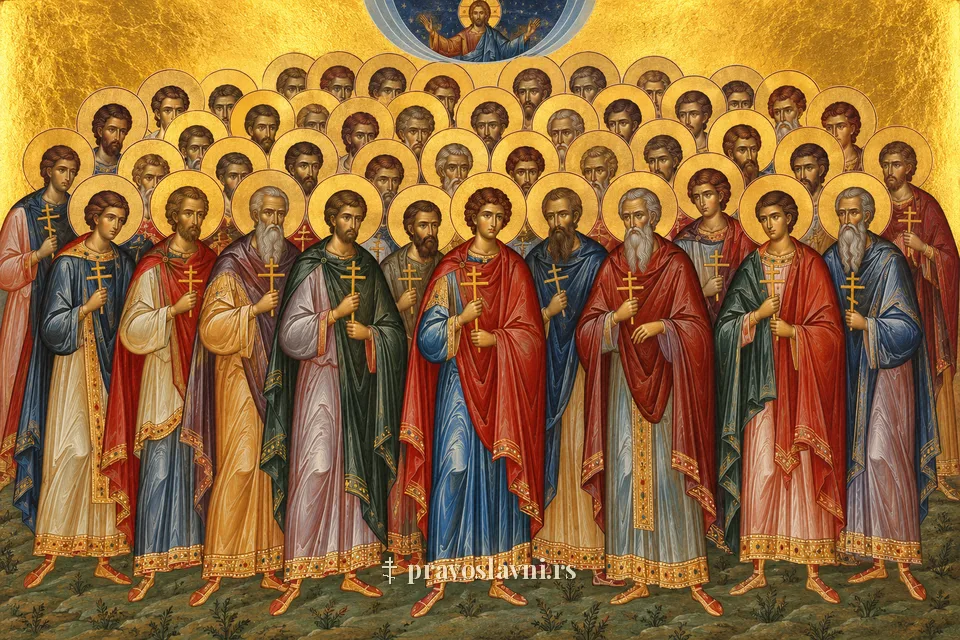
Holy 45 Martyrs of Nicopolis in Armenia
What happenedThe forty-five martyrs of Nicopolis in Armenia confessed Christ in the time of the Emperor Licinius, and by their courage brought even their gaolers to Christ.
Read the LifeOrthodox Calendar · 10 July according to the Julian calendar
Friday, 23 July 202710 July (according to the Julian calendar)What happenedThe forty-five martyrs of Nicopolis in Armenia confessed Christ in the time of the Emperor Licinius, and by their courage brought even their gaolers to Christ.
Read the Life
No meat, dairy products, eggs, fish or oil — food cooked in water.
This is a recommendation — for your own fast, consult your priest or spiritual father.More about the fast →
Today the Church keeps the commemoration of a saint · not a Red Letter day.
More about the feast →
“For as in Adam all die, even so in Christ all shall be made alive.”
— 1 Cor 15:22The company of the forty-five martyrs of Nicopolis in Armenia began with only a few. Leontius and his companions confessed the faith before the governor Lysias, at the time of the persecution under the Emperor Licinius. Lysias asked: “And where is your Christ?”, and Leontius answered: “since you know that our Christ died, know that He also rose from the dead.”
For this they were beaten and shut up without food or water. Water was brought to them through the window by Vlassiana, a woman of noble family, and the Prologue says that an angel of God encouraged them in the prison. At the trial two gaolers and many others joined them, so that there were forty-five of them. All were condemned, tortured and thrown into the fire, in the year 319.
This company of martyrs grew in the course of the trial itself. It began with Leontius and a few of his companions in Nicopolis in Armenia, who did not hide their faith before the governor Lysias. When the time came for the sentence, two gaolers also declared themselves Christians, and many others as well, and so they came to be forty-five. The Prologue mentions by name Leontius, Maurice, Alexander and Sisinius. This was in the time of the persecution under Emperor Licinius, the ruler of the eastern part of the empire.
Lysias asked Leontius: “And where is your Christ?” — and reminded him that Christ was crucified and that He died. Leontius turned his answer into a testimony: “since you know that our Christ died, know that He also rose from the dead.” The dispute went on for a long time, and it ended in beatings and in prison, where the confessors were given neither food nor water.
Yet they were not forsaken. Vlassiana, a woman from a distinguished family, saw to it that they were not left without water, which she passed to them through the window. The Prologue says that an angel of God also visited them in prison and encouraged them.
In the end the judge condemned all forty-five to death. After being tortured they were thrown into the fire, and their souls departed to the Lord in the year 319.
Venerable Anthony of the Kiev Caves was born in Lyubech, a small town near Chernigov, according to his Life in the time of Grand Prince Vladimir. While still young he left his homeland and, according to his Life by way of Greece and Constantinople, came to the Holy Mountain (Mount Athos), where he was tonsured a monk, according to the Prologue at Esphigmenou. The Prologue says that the abbot, following a revelation, decided to send him back to Russia so that he might plant the monastic life there, and his Life adds the prophecy that Anthony would gather many spiritual sons around him. His Life says that he did not find the existing monasteries in Kiev strict enough, so he settled in a cave at Berestovo. After one more journey to the Holy Mountain he returned and settled in a small cave which the presbyter Hilarion had dug, and he enlarged it, and disciples began to gather around him. According to his Life, at his word Nikon tonsured the twenty-three-year-old Theodosius, and the brotherhood grew to twelve. According to his Life, he first entrusted the office of abbot to Barlaam; the Prologue says that he later handed the brethren over to Theodosius, while he himself remained in the cave. According to his Life, the monastery was built on the ground above the cave, and the Prologue calls it the mother-house of Russian monasticism. By his meekness, says the Prologue, he overcame many attacks of men and demons. He was clairvoyant and healed the sick, according to his Life with herbs. He reposed in the year 1073, in his ninetieth year, according to his Life on 10 July (according to the Julian calendar), in his cave. His Life says that his relics remained hidden and that healings were recorded after his death.


