Sunday31October 202718 October (according to the Julian calendar)‹›
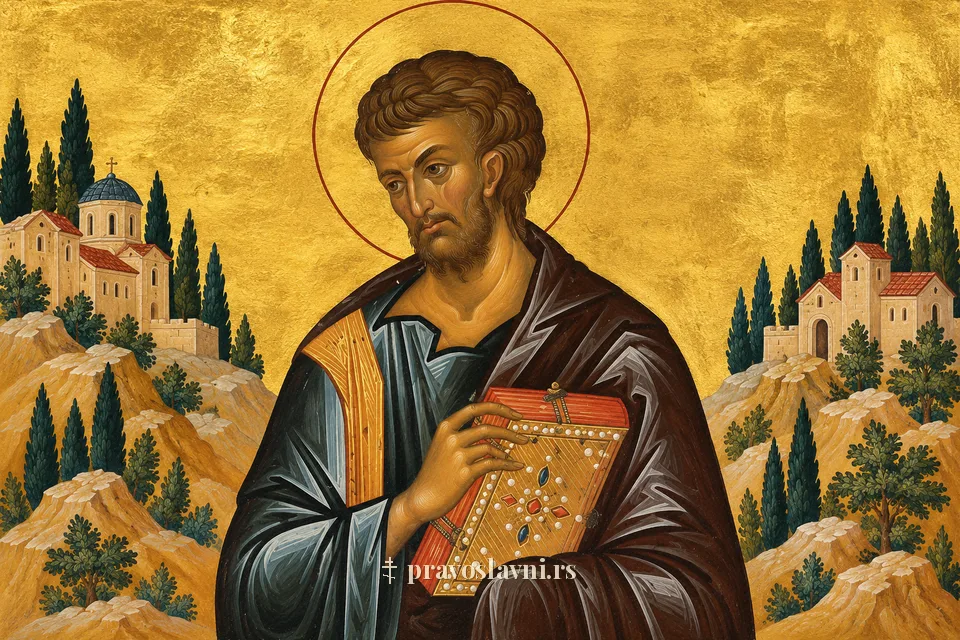
Illustration
Great feast
Lučindan — Holy Apostle and Evangelist Luke
Holy Apostle and Evangelist Luke
What happenedA physician and painter from Antioch, the author of a Gospel and of the Acts of the Apostles, the founder of iconography; on the same day, St Peter of Cetinje, bishop and ruler of Montenegro.
Lučindan is the feast of the holy Apostle and Evangelist Luke. The name Luke, Lucius, is interpreted as the Latin word for light. Many Serbian families celebrate Lučindan as their Krsna slava (family patron saint's day). With him, it is held, Christian iconography begins: according to tradition, it was he who painted the first icons of the Theotokos with the Christ Child, three of them, and she blessed them. For more on fasting on this day, see the guide “Fasting — simply explained”.
Antioch in Syria. The Prologue says that in his youth Luke studied Greek philosophy, medicine and painting well. He was an educated man, a physician.
But at the time when the Lord Jesus walked the earth, Luke came to Jerusalem. The Prologue says that he saw the Saviour face to face and listened to His teaching. He believed, and was numbered among the Seventy Apostles. The Prologue records that together with Cleopas he saw the risen Lord on the road to Emmaus.
Later he became the travelling companion of the Apostle Paul. When Paul was placed under guard, Luke remained beside him. The Prologue quotes Paul's words to the Colossians: “Luke the beloved physician greets you.” And when, towards the end of his life, in Rome, they left Paul one by one, he wrote a short sentence which the Life quotes: “Only Luke is with me.”
The Prologue says that Luke, at the request of the Christians, wrote the Gospel, and then the Acts of the Apostles as well. The Prologue also says that Luke painted three icons of the Most Holy Theotokos, as well as icons of the Apostles Peter and Paul.
The Prologue says that in his old age he visited Libya and Upper Egypt, and then returned to Greece and went on preaching regardless of his great age. He was eighty-four years old when malicious idolaters, as the Prologue says, put him to torture for Christ's sake and hanged him on an olive tree in the city of Thebes in Boeotia.
St Luke teaches us that the gift of knowledge and talent is greatest when it is placed at the service of Christ and of one's neighbour, and that faithfulness does not abandon a person in trouble.
On the same day the Church also commemorates St Peter of Cetinje (1749–1830), Metropolitan and ruler of Montenegro — read his Life below, among the other saints of the day.
Full Life
Holy Apostle and Evangelist Luke
The physician who became a witness
Luke was not a fisherman from the Sea of Galilee. He came from the wide world, from Antioch in Syria, which was then one of the most renowned of cities. The Prologue presents him to us as a man of much learning: he was versed in the wisdom of the Greek philosophers, he healed people, and he also knew how to paint. According to his Life, he spoke Egyptian as well, not only Greek. A physician by calling, learned and gifted — such was the man who came before Christ.
But the most important thing he learned in Jerusalem. According to the Prologue, he did not know Christ from the stories of others: while the Lord still walked upon the earth, Luke saw Him and listened to Him, and he watched the miracles with his own eyes. He believed and entered the number of the Seventy Apostles.
The Crucifixion, according to his Life, found him in Jerusalem, and he bore it hard. And then came Emmaus. The Prologue says that Luke, together with Cleopas, was one of the two who met the risen Lord on that road. Whoever has read that page of his Gospel knows how it ends: they recognised the Lord only at table, when He broke the bread. Reading it, we are also reading Luke's own personal testimony.
The friend who does not leave
After the descent of the Holy Spirit, as his Life records, he set out back to Antioch. On the way, in Sebaste, he took the right hand of St John the Baptist and carried it with him. Soon he attached himself to the Apostle Paul, and from then on their paths ran together. His Life states that Paul left him to lead the Church in Philippi for several years. He was at Paul's side in Caesarea too, while the Apostle was in chains, and at sea, on the long and dangerous voyage to Rome. It is no wonder that Paul, as the Prologue reminds us, writes to the Colossians: “Luke the beloved physician greets you.”
His greatest faithfulness he showed at the end. Paul's last epistle, written to Timothy from a Roman prison, speaks of how everyone had gone their separate ways. His Life quotes one short sentence from it: “Only Luke is with me.” Under Nero, to be the friend of a condemned man meant putting one's own head at stake as well. Luke stayed.
The pen and the brush
The Prologue says that around the year 60, because the Christians asked for it, he wrote his Gospel. Its continuation is the Acts of the Apostles, and both books are addressed to Theophilus. Thanks to him we know of the Annunciation in Nazareth, of the shepherds near Bethlehem, of the elder Simeon and the twelve-year-old Jesus in the temple, of the prodigal son and the good Samaritan.
The Prologue also regards him as the first iconographer: he painted three icons of the Theotokos and the likenesses of the Apostles Peter and Paul. According to his Life, which refers to ancient writers, the Theotokos blessed those icons with the words: “May the grace of Him Who was born of me, and my own, be with these icons.”
To the last breath
After Paul's death Luke went on alone, from Macedonia and Dalmatia to Italy. Not even his years stopped him: the Prologue mentions that even as an old man he preached in Libya and Upper Egypt. According to his Life, in Alexandria he appointed Abilius as bishop. The Prologue says that he ended his life on an olive tree in Thebes of Boeotia. There the idolaters hanged him, after the torments he had endured for the sake of Christ. He was then eighty-four years old.
Luke shows us that knowledge and talent are worth the most when they serve Christ and our neighbours, and that the faithful do not abandon one who is in trouble.
On the same day the Church also commemorates St Peter of Cetinje (1749–1830), Metropolitan and ruler of Montenegro — read his Life below, among the other saints of the day.
Other saints of the day
St Peter of Cetinje
Peter was born on 1 April 1749 in Njeguši. Metropolitan Sava, his relative, chose him while still a boy as his successor and took him to the Cetinje Monastery to learn his letters, and according to the Prologue he became a monk in his twelfth year. After Sava's death in 1782 he stood at the head of the Church and the people. Above all he laboured for peace among the feuding clans: according to his Life, he kept returning to those at feud until they were reconciled. Though the head of the land, he lived in a cramped cell like an ordinary monk, strict with himself, just and gentle with others. To feed the poor he pawned both his own and the monastery's property. Before his death he asked forgiveness of all and bound the people by oath that no one would harm anyone until Đurđevdan (St George's Day). He reposed on 18 October 1830, on the feast of St Luke. His relics were found incorrupt and rest in the Cetinje Monastery. Peter teaches us that peace is built by the one who seeks nothing for himself.