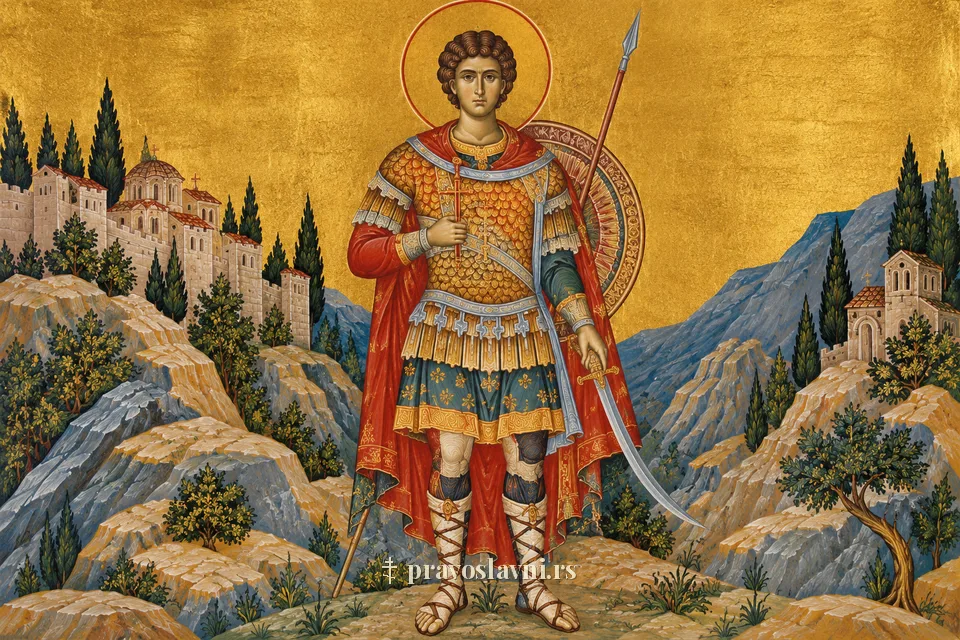
Saint of the day
Holy Martyr Nestor of Thessalonica
What happenedThe young Nestor, with the blessing of St Demetrius, cried out “O God of Demetrius, help me!” and threw the giant Lyaeus down onto the spears.
Read the LifeOrthodox Calendar · 27 October according to the Julian calendar
Tuesday, 9 November 202727 October (according to the Julian calendar)Save your slava — you'll get a reminder a week and a day before.
Send a greeting card →What happenedThe young Nestor, with the blessing of St Demetrius, cried out “O God of Demetrius, help me!” and threw the giant Lyaeus down onto the spears.
Read the Life
You may eat meat, eggs, milk and dairy products, as well as any other food — but try to be moderate.
More about the fast →
Many families celebrate their Krsna slava (family patron saint's day) today
More about the feast →
“I can do all things through Christ who strengthens me.”
— Phil 4:13The Prologue records that one day the spectators in Thessalonica roared: “Great is the God of Demetrius!” The occasion was unexpected: the young Nestor had overcome Lyaeus, the Emperor's wrestler whom no one could defeat, and Lyaeus perished on the spears beneath his own platform.
Who was Nestor? A strong man of Thessalonica in his early youth, who had come to know Christ thanks to St Demetrius and had stayed close to him. The Emperor Maximian was then persecuting Christians, and he was holding Demetrius in prison. Lyaeus, a Vandal of gigantic stature — his Life says that people saw in him a dwelling-place of unclean spirits — had taken countless lives. Christians were led out against him by force whenever there were no volunteers, and their brethren among the spectators watched them perish one after another.
Those deaths gave Nestor no peace. He came forward of his own accord — but only after he had received his teacher's blessing in the prison and had heard from him: “You will defeat Lyaeus, but you will suffer for Christ.” According to his Life, he threw off his cloak before everyone and announced that he would fight Lyaeus. His Life also records a short conversation with the Emperor: to the remark that he was small and young, Nestor replied that he did not rely on his own strength, but on Christ's. The Emperor's pity turned to anger as soon as he understood with whom he was dealing, and the young man was sent onto the platform to perish, as the Emperor thought, like the others. Before the fight he called upon the God of Demetrius for help. His Life compares his victory with that of David over Goliath.
The Emperor left the arena put to shame. He then laid the blame on Demetrius as well, whose blessing Nestor had carried, and so death came to them both — to the disciple by the sword, to the teacher by spears. The Prologue gives the year 306 for Nestor's suffering, and the Church celebrates him on the day after Mitrovdan.
Nestor teaches us that brute force can do nothing against one who relies on Christ. Small and young, he won the victory over the invincible, and then without fear gave his life for his Lord — and with his teacher received a crown in the Kingdom of Heaven.
Lyaeus was a Vandal, huge and strong, and the Emperor Maximian valued him above all his fighters. His Life adds that he had a voice that struck fear, that it was believed unclean spirits lived in him, and that countless men who had matched themselves against him had lost their lives. A fight with him had no way out: whoever was defeated ended on the spears that waited beneath the raised platform, built for him on pillars.
Who would stand before such an opponent? There were no volunteers. That is why Christians were driven to the fight, and many of them lost their lives there. Their brothers in the faith, mingled with the multitude of spectators, watched in pain what was happening.
This was Thessalonica in the time of persecution. His Life also calls the Emperor Maximian Herculius and mentions him as the friend and co-ruler of Diocletian. Having, according to his Life, rid himself of Demetrius by throwing him into prison for the sake of Christ, the Emperor spent his time at the games.
Nestor was in his first youth, still almost beardless, but strong. He had received the faith from Demetrius himself and was close to him. Every new Christian victim on the platform weighed upon him, until he decided to stand against Lyaeus himself.
Before the fight, however, he went to quite a different place — to the prison. There was a man there from whom he asked a prayer and a blessing. From there he carried away the sign of the cross and a prophecy that would be fulfilled to the last letter: “You will defeat Lyaeus, but you will suffer for Christ.”
According to his Life, the first sign that something was afoot was a cloak that fell to the ground. Nestor threw it off and cried out: “I want to fight Lyaeus!”
The Emperor was taken aback. According to his Life, he tried to dissuade him, pitying his youth and reminding him of the fate of men stronger than he. Nestor answered him that he did not seek strength in himself, but in Christ. The name of Christ on the young man's lips enraged the Emperor, and Nestor went out onto the platform all the same.
On the platform his support was the cross and his teacher's prayer. Before the Emperor and the crowded arena he called for help: “O God of Demetrius, help me!” Nestor then overcame Lyaeus and hurled him down, and the giant perished in his own trap. His Life sees in this the same thing as in David's victory over Goliath — the strength that God gives to the weak. The arena resounded, and the Christians rejoiced most of all. The Prologue remembers their cry: “great is the God of Demetrius!”
The Emperor left the arena ashamed, sad and angry, and Nestor was soon arrested at his command. Only then did the turn of Demetrius come as well: the knowledge that Nestor had gone into the fight with his blessing cost him his life. Teacher and disciple died by different weapons, but for the same Lord: Demetrius by spears, Nestor by the sword. The Prologue gives 306 as the year of Nestor's suffering, while his Life does not mention the year. Thus the prophecy from the prison was fulfilled in both its parts.
The Church celebrates St Nestor on 27 October by the old calendar, that is, 9 November by the new — the day after St Demetrius. Teacher and disciple thus stand side by side in the calendar as well.
Nestor's story is not a story about muscles. It is the story of a young man who knew that he was small, and yet was not afraid, because he leaned on Christ. The brute force of the giant fell before the cross and the teacher's blessing, as Goliath once fell before David. And when the hour came to lay down his life for Christ, Nestor did not draw back. That is why the Church celebrates both him and Demetrius as victors, crowned in heaven.


