Tuesday23November 202710 November (according to the Julian calendar)‹›
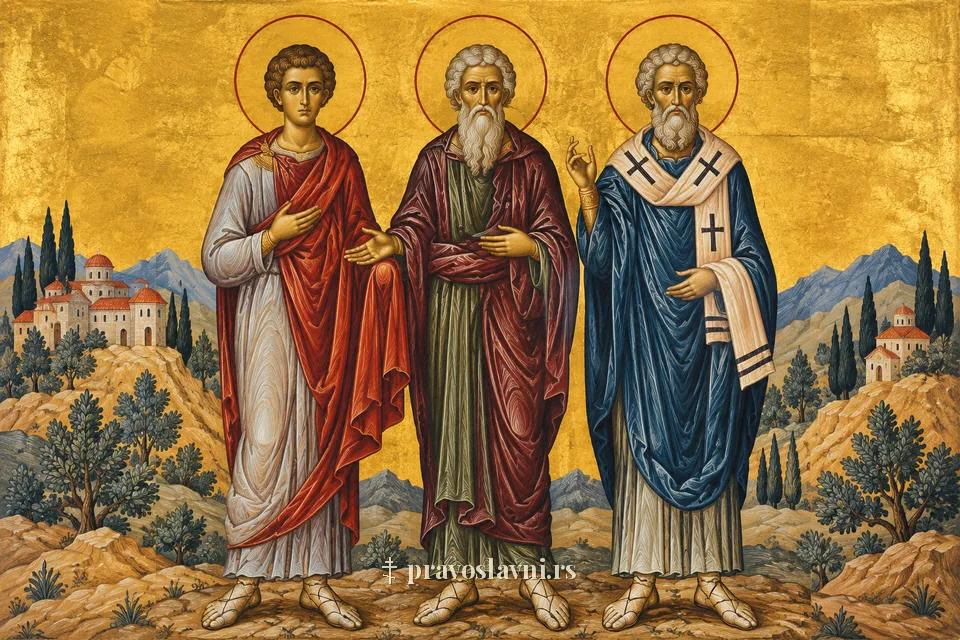
Illustration
Saints of the day
Holy Apostles Olympas, Erastus, Herodion and others (of the Seventy)
What happenedOlympas and Herodion, companions of the Apostle Peter, did not leave him even in death: by Nero's command they too were put to death by the sword.
Sts Olympas, Erastus, Quartus, Herodion, Sosipater and Tertius belong to the Seventy Apostles. The Prologue and their Life write about them briefly, but enough for us to see how each one found his own place in the service of the Gospel.
Peter's companions Olympas and Herodion shared martyrdom with him as well: by Nero's command they were beheaded at the time of his suffering.
Erastus, whom the Apostle Paul, as their Life reminds us, mentions in the Epistle to the Romans, was Bishop of Paneas in Palestine; before that he had looked after the property of the Church of Jerusalem as its steward. Many people in Beirut became Christians thanks to Quartus, the bishop there, who endured many hardships for it. Sosipater and Tertius were, one after the other, bishops of Iconium. In this way one city twice received a shepherd from the circle of the Seventy. Herodion, Sosipater and Tertius also have their own separate commemorations: those of Herodion and Sosipater fall in April, on the 8th and the 28th, and that of Tertius on 30 October, by the old calendar.
When they died and where they rest, the sources do not say. Their Life sums up their lives in the words: “Spiritually they fought for the Gospel, they were victors, and they were crowned with crowns of glory.”
Their example teaches us that the Gospel is served in many ways: beside a great teacher, in caring for the Church, or as the shepherd of one's own city. Everyone who serves faithfully where God has placed him can receive the crown of victory.
Full Life
Six of the Seventy
These Apostles of the Seventy have not been remembered through long stories. About Olympas, Erastus, Quartus, Herodion, Sosipater and Tertius the Prologue and the Life say only a few sentences, and the Church celebrates them together. Yet even from that short record it can be seen how many different paths led to the same goal: one followed Peter, one took care of the goods of the Church, and one became the shepherd of a city.
Beside the Apostle Peter
Two of them, Olympas and Herodion, walked in the footsteps of the Apostle Peter. Their death is bound up with Peter's: when he suffered, Nero's command sent the two of them to the place of execution as well, and both were beheaded. They followed him, then, not only along the roads, but into death too. It is not recorded what they said or how they preached, but faithfulness to the end speaks in place of words.
From steward to bishop
Erastus at first served the Church of Jerusalem as its steward, looking after its property. His name is also preserved in Holy Scripture: the Life reminds us that the Apostle Paul mentions him in the Epistle to the Romans (16:23). Later on Paneas in Palestine received in him its bishop, and so the one who had guarded the goods of the Church began to guard souls as well.
Troubles did not pass Quartus by either, the Bishop of Beirut, but thanks to him many received Christ.
Two of this company, Sosipater and Tertius, led the Church in Iconium one after the other — Tertius as the second bishop of that city. In this way one city twice received a shepherd from the circle of the Seventy.
Some of them also have a separate commemoration: Herodion's falls on 8 April, Sosipater's twenty days later, and that of Tertius on 30 October (by the old calendar). When they died, where their grave is and what became of their relics — about this the sources are silent.
The crown of victors
The Life closes their whole story with a single sentence: “They fought spiritually for the Gospel, they were victors, and they were crowned with crowns of glory.” More than that is not even needed for us to understand what their life was.
The Apostles of the Seventy laboured and suffered for the Gospel alongside Peter and Paul, each in his own place, and all of them received the reward of victors. Each was faithful in what had been entrusted to him. We too need not be great in order to serve Christ: it is enough that we serve faithfully in the place where God has set us.