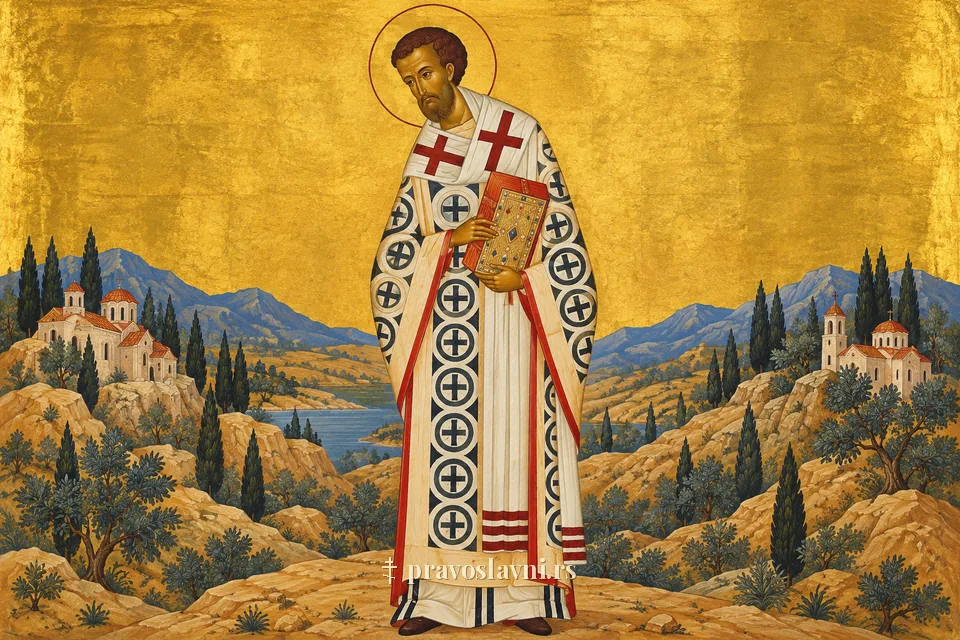
Saint of the day
St John Chrysostom
What happenedA simple woman in Antioch, who could not follow his profound sermons, called John “the Golden-mouthed” (Chrysostom) — and the Church calls him so to this day.
Read the LifeOrthodox Calendar · 13 November according to the Julian calendar
Friday, 26 November 202713 November (according to the Julian calendar)Save your slava — you'll get a reminder a week and a day before.
Send a greeting card →What happenedA simple woman in Antioch, who could not follow his profound sermons, called John “the Golden-mouthed” (Chrysostom) — and the Church calls him so to this day.
Read the Life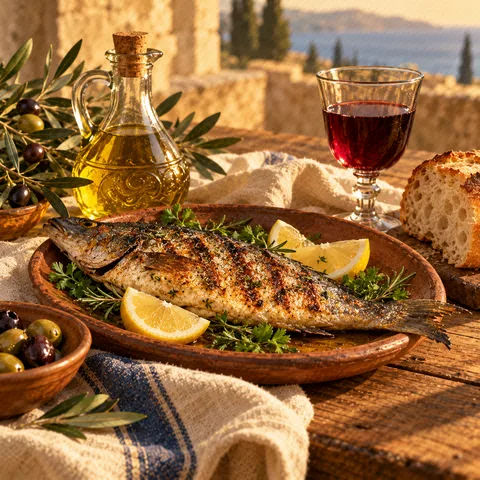
Fish, oil and wine are allowed — no meat, dairy products or eggs.
This is a recommendation — for your own fast, consult your priest or spiritual father.More about the fast →
Many families celebrate their Krsna slava (family patron saint's day) today
More about the feast →
“Preach the word! Be ready in season and out of season. Convince, rebuke, exhort, with all longsuffering and teaching.”
— 2 Tim 4:2Sung at the Slava (family patron saint's feast) and on the saint's feast day.
The grace of thy mouth, shining forth like a beacon of fire, hath enlightened the universe; it hath laid up for the world no treasures of avarice, but hath shown us the height of humility. But as thou instructest us by thy words, O father John Chrysostom, entreat the Word, Christ God, that our souls be saved.
Translation: pravoslavni.rs
St John Chrysostom was born in Antioch, in Syria. His father, the commander Secundus, died early, and his mother Anthusa, widowed while still young, brought him up as a Christian. Among the pupils of the famous Libanius he was the best, but Greek philosophy did not keep him in paganism: he turned to Christ. He was baptised by Patriarch Meletius.
His mother's death opened the way for him to the monastery, which he entered after giving away everything he had. There the elder Hesychius, according to the Prologue and his Life, saw the Evangelist John and the Apostle Peter come to John, and they foretold to him that he would suffer much for the sake of righteousness.
As a presbyter in Antioch he drew, his Life says, the whole city to himself, so that even the shops stood empty while he was speaking. The name Chrysostom, “Golden-mouthed”, which the Church keeps to this day, was given to him by a woman of the people, for whom his homilies were too difficult; from then on he spoke more simply.
Emperor Arcadius chose him to be Patriarch of Constantinople, and the Prologue records that he was on that throne for six years. He opened hospitals, in which 7,700 poor people were fed, he sent out missionaries, interpreted the Scriptures and fought against the selling of holy orders. As patriarch too he remained an ascetic: he ate modestly and avoided banquets. He did not keep silent before the powerful either, not even before Empress Eudoxia. To her envoys he said: “I rebuke iniquities, and not those who commit them.” In this way he made many enemies.
The Synod of the Oak, behind which stood the intrigues of Theophilus of Alexandria, deposed him, but after unrest in the city and an earthquake he was brought back. When he condemned the festivities around the silver statue of Empress Eudoxia, he was exiled again, to Cucusus, from where he wrote many letters. The Prologue records that the empress banished him twice and that he spent three years in exile. He reposed on 14 September 407, in Comana, while they were leading him into an even more distant exile. His last words were: “Glory to God for all things!”
Thirty years later the empress's son, Emperor Theodosius the Younger, translated his relics to Constantinople and asked the saint for forgiveness. In 1204 the Crusaders carried the relics off to Rome, and in 2004 they were returned to Constantinople. His Life says that, when the coffin was placed on the patriarchal throne, the voice of the holy hierarch was heard: “Peace be unto all!”
The life of St John Chrysostom teaches that the truth should be spoken without fear, that the poor should be loved in deed, and that in every trouble we should give thanks to God.
Whom would he see as his successor, they asked the famous sophist Libanius on his deathbed. His Life records the answer: “John, if the Christians had not stolen him from us.”
John was born in Antioch, the capital of Syria. His father was the commander Secundus, and his mother was Anthusa. The Prologue gives 354 as the year of his birth, while his Life says that he was born around 347. Secundus died while his son was still small, and Anthusa, a widow of about twenty years of age, refused a new marriage so that she might bring up her son in the faith. Greek philosophy, which he studied, only turned him away from paganism and led him to Christ, but he was baptised only as a grown man, by the hand of Meletius, Patriarch of Antioch.
His friend Basil called him to become a monk, but his mother wept and begged him not to leave her while she was alive — and John gave way. When Anthusa was gone, nothing held him in the world any longer: his property went to the poor, he made free people of his slaves, and he himself entered a monastery, under the guidance of an elder. According to the Prologue and his Life, the elder Hesychius then saw two apostles in John's cell, the Evangelist John and Peter. The Evangelist, according to his Life, handed him a scroll of wisdom for the teaching of the people, and Peter the keys of the authority to bind and to loose; both of them, the Prologue and his Life record, warned him that many sufferings for the sake of righteousness awaited him.
After years of ascetic struggle in the monastery and in a cave, John, gravely ill, returned to Antioch. There Meletius made him a deacon, and he received the rank of presbyter from Flavian, the successor of Meletius — according to the Prologue and his Life, at the command of an angel, who named John to Flavian as a chosen vessel. Throughout Syria, according to both sources, the news spread of a miracle at the ordination, when, before the eyes of everyone in the church, a dove shining with whiteness hovered over the new presbyter.
Whenever he preached, his Life says, Antioch came to a standstill: the shops, the workshops and the courts emptied, and his listeners gave him names such as the mouth of God and the honeyed tongue. The name that stayed with him was given to him, according to his Life, by a woman of the people, who, unable to follow his theology, complained aloud and called him the Golden-mouthed. From then on John spoke more simply, so that everyone could understand him.
Emperor Arcadius chose him as Patriarch of Constantinople, and the Prologue records that he was on that throne for six years. The sick and the homeless received hospitals and guest-houses; in two hospitals in Constantinople he cared for 7,700 of the poor. The Prologue also points out that he wrote the order of the Divine Liturgy and many homilies. Even as patriarch he ate barley bread, drank water, slept little and kept away from banquets.
Nor did he keep silent before the imperial court. To Empress Eudoxia, who demanded that he stop reproaching her, he sent word: “I rebuke lawless deeds, not the lawless.” His opponents, among them Theophilus of Alexandria, searched through his past as far back as Antioch, but they found nothing with which to accuse him.
The intrigues of Theophilus of Alexandria brought him before a council which, from its place, is called the Synod of the Oak, and there John was deposed and sent into exile. Constantinople was in turmoil, and on the night when he was taken away an earthquake shook the city. The Empress took fright and herself asked for the patriarch to come back, and Arcadius called him back almost at once.
The peace did not last long. Beside the cathedral church a silver statue of Empress Eudoxia was set up, and John publicly condemned the festivities with which the statue was dedicated. The second exile was harder and took him to distant Cucusus. The Prologue sums up those years briefly: the Empress banished him twice, and he spent three years in exile. Even then he did not fall silent: from there he wrote many letters, among them seventeen to the deaconess Olympias.
At last the order came to take him still farther, towards Pityus on the Black Sea, but he never arrived there. Towards the end, the Prologue records, the apostles John and Peter appeared to him again, and he received Holy Communion for the last time in the church of St Basiliscus. He reposed on the road, in Comana, on 14 September 407, on the feast of the Exaltation of the Cross. His last words were: “Glory to God for all things!”
Thirty years after his death Emperor Theodosius the Younger, the son of the empress who had banished him, sent for his relics. The Prologue and his Life say that the relics became immovable until the Emperor wrote a letter and begged the saint for forgiveness. In the year 438 the coffin was placed on the patriarchal throne in the Church of the Holy Apostles, and then, according to his Life, the voice of the hierarch was heard: “Peace be unto all!” Later the relics made one more journey: the crusaders carried them off to Rome in 1204, and in 2004 they were returned to Constantinople.
St John Chrysostom teaches that the truth is to be spoken without fear, that the poor are to be loved in deed, and that in time of trouble thanks are to be given to God.


