Thursday25November 202712 November (according to the Julian calendar)‹›
Illustration
Saint of the day
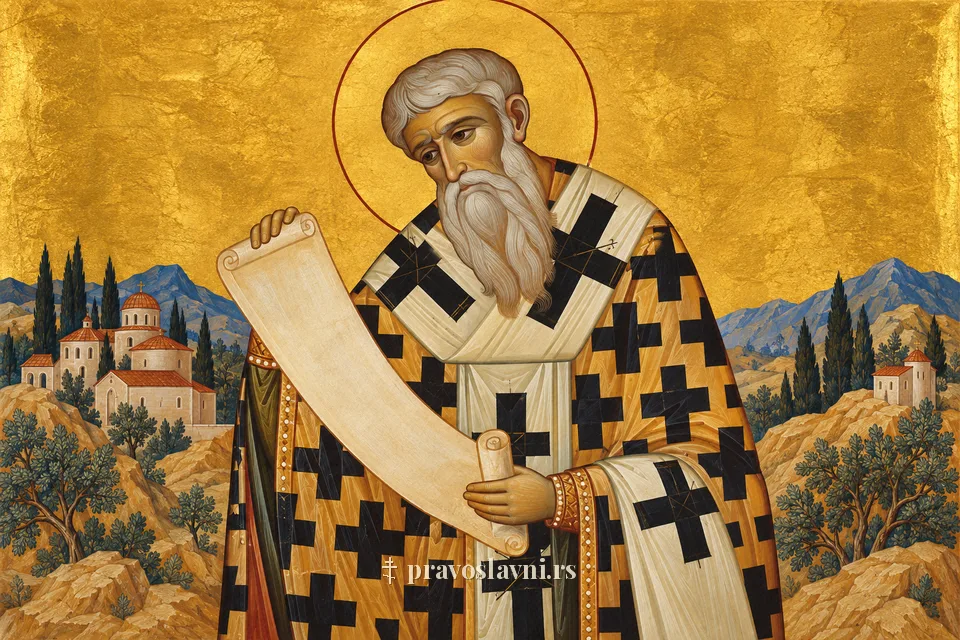
St John the Merciful, Patriarch of Alexandria
What happenedPatriarch John the Merciful ordered that the poor of Alexandria be counted and that all seven and a half thousand of them be fed every day at the expense of the Church.
Sung at the Slava (family patron saint's feast) and on the saint's feast day.
By thy patience thou didst gain thy reward, O venerable father, persevering unceasingly in prayer, loving the poor and providing for them abundantly. But entreat Christ God, O merciful John, blessed one, that our souls be saved.
John the Merciful, the son of Epiphanius, the prince of Cyprus, lived devoutly from his childhood. He obeyed his parents, married and became a father, but God took both his children and his wife. The Prologue and his Life see in this a providence that set him free for the spiritual life.
He was appointed Patriarch of Alexandria by the Emperor Heraclius, and John accepted that office only under compulsion. The Prologue credits him with ten years as patriarch, during which neither heresy nor paganism found a way to his flock.
His Life gives the most space to his care for the destitute. All the poor of Alexandria, whom the stewards listed at his instruction — there were about seven and a half thousand of them — received food from the Church every day, and John called them his masters, because he saw in them the way of his salvation. The captive Christians whom the Persians had carried off when they burned Jerusalem he ransomed with gold and wheat sent across the sea. On Wednesdays and Fridays anyone could find him in front of the church and ask him for justice.
He was convinced that God repays almsgiving a hundredfold, and his Life gives many such examples. Yet when a storm carried away the cargo of thirteen ships belonging to the Church, he looked for the fault in himself: “I grew proud, giving away what was not my own but God's.” According to his Life, the loss was afterwards made up to him twice over.
He showed humility in the middle of the Liturgy too, which he interrupted so that, following Christ's word about being reconciled before offering one's gift, he might ask forgiveness of a cleric with whom he was angry. He showed his nephew George that true nobility is gained by virtue, and he told everyone to beware of hasty judgement, because another person's repentance is not seen.
When war reached even Egypt, he set out by sea for Constantinople. A radiant messenger told him that the King of kings was calling him. The journey ended at Amathus, John's birthplace on Cyprus, where, according to the Prologue, he died in the year 620. He gave thanks to God that he was leaving almost nothing behind him: everything he had, he had given to Christ.
John teaches us that almsgiving, humility and not judging others lead a person straight to God.
Full Life
A nobleman who became the servant of the poor
The man whom we remember for the poor came from a governor's house on Cyprus, the son of the governor Epiphanius. The faith was given to him at home, from his childhood. He entered into marriage because his parents wished it, and the children who were born did not live long; after them his wife died too. Both sources see in this the providence of God: his earthly ties were broken so that the way to the spiritual life might be opened to him.
When the see of Alexandria fell vacant, Emperor Heraclius appointed him Patriarch. He consented only when he had to. According to the Prologue, he governed the patriarchate for ten years, and in that time neither pagans nor heretics gained ground in it. His Life adds that he rooted out from his flock the heresy of Peter the Fuller, who had added words about the crucifixion to the Trisagion hymn.
Why he called them his lords
His Life explains where such love for the poor man came from. As a fifteen-year-old he had a vision of a maiden with an olive wreath, and that maiden was Mercy. From then on, giving became for him a test of God's word that whoever gives receives a hundredfold. He put it to the test many times and always found that it was true.
According to his Life, he called the poor of Alexandria his lords, because they were able to help him to be saved. When the stewards counted them, there were seven and a half thousand of them, and from then on each one received food from the Church's treasury every day. The Persian campaign against Syria and Palestine, in which Jerusalem burned and the Precious Cross was carried off, left behind it a multitude of captive Christians; John paid their ransom with gold and with grain carried by his ships. Nor would he allow any inquiry into who was truly poor: the commandment is to give, and not to judge, and the Church's treasure, he believed, would not be exhausted even if all the poor of the earth gathered in the city.
His Life tells that the refugees brought famine, and so John spent everything the Church had and went into debt by a further thousand pounds of gold. Even so he would not, for money and wheat, ordain a cleric who had been twice married, remembering Gehazi. His Life records that the answer arrived that very day, by sea: two ships of the Church laden with Sicilian wheat.
Humility before God and men
When the cargo of thirteen ships, worth 3,300 pounds of gold, was lost in a storm on the Adriatic, John accepted the loss and said: “I grew proud, giving away what was not mine but God's.” His Life says that the Lord gave him back twice as much.
Both sources also remember the Liturgy that stopped in the middle of the service: before the Holy Gifts the Patriarch was struck by Christ's word about being reconciled before offering one's gift, and so he left them and sought out a cleric against whom he bore a grudge. He returned to the offering when peace had been restored. In the same way they remember the road to the church of the holy martyrs Cyrus and John, on which a poor widow stopped him with her trouble. His retinue was hurrying to the service, but the Patriarch would go no further until he had heard her out: the prayer of one who does not listen to others, he held, will not be heard by God either.
According to his Life, when a certain innkeeper insulted his nephew George, John first pretended to be angry, and then forgave the innkeeper a year's rent. The Prologue also preserves the words which he addressed to his nephew: “If you desire nobility, do not seek it in blood but in virtue.” He ordered his coffin in advance, but on condition that it remain unfinished, and the craftsmen had the task of reminding him on feast days that death comes like a thief. From several cases in which monks were unjustly suspected he drew a lesson: do not judge hastily, for repentance cannot be seen.
What he left behind him
When the Persians attacked Egypt, John sailed for Constantinople, keeping to the word that one who is persecuted should flee to another city. On the way he fell ill and in a vision he heard: “The King of kings is calling you to Himself.” He reached his native Amathus on Cyprus and there he reposed, according to the Prologue in the year 620.
When, according to both sources, he was reckoning his accounts on his deathbed, it turned out that all the gold that had passed through his hands — about eight thousand pounds found there and more than ten thousand collected — had gone to Christ. His thanksgiving to God had an unusual cause: in his estate there was found barely a third of a silver coin, and even that he assigned to the poor. He was buried in the church of St Tikhon the Wonderworker, and his Life says that two bishops, already laid to rest in that place, made room for him with their bodies. Nor did the relics remain on Cyprus: the Prologue follows them, as wonderworking, to Constantinople, then to Budapest and finally to Pressburg.
The lesson: what you give to the poor man you do not lose, and whoever does not exalt himself and does not judge others is close to God.
Other saints of the day
Venerable Nilus of Sinai
Venerable Nilus was born in Constantinople, and his Life says that he was well educated and a skilled speaker. He was married to an honourable woman, with whom he had a son, Theodulus, and a daughter, and he held the office of prefect of Constantinople. The vanity and corruption of the capital became so hateful to him that he persuaded his wife that they should leave the world together, and his Life records that they shared out their estate among the poor and set their slaves free. The family then parted: Theodulus went with his father to Mount Sinai, while the daughter with her mother found a place in an Egyptian convent for women. On Sinai he became a monk and, according to his Life, dug out with his own hands the cave in which he lived. When St John Chrysostom was exiled, Nilus, according to his Life, wrote to Emperor Arcadius and condemned that injustice. His Life also tells of a barbarian raid on Sinai, in which many monks were killed, and among those taken captive was Theodulus, of whom his father heard that he was intended as a sacrifice to the idols. Yet by God's providence freedom awaited Theodulus: he was ransomed by the bishop of Emesa, who then received him into the clergy. In Emesa Nilus, in spite of his own resistance, received the rank of presbyter, but the father did not agree to stay there and returned with his son to his own desert. Sinai was the arena of his ascetic struggle for six decades, and he also left valuable books on the spiritual life. “The passions of the body have their origin in the needs of the body,” he wrote, and for the bridling of the passions he recommended abstinence and prayer. A peaceful death came for him around the year 450; the Prologue adds that he was then eighty years old.