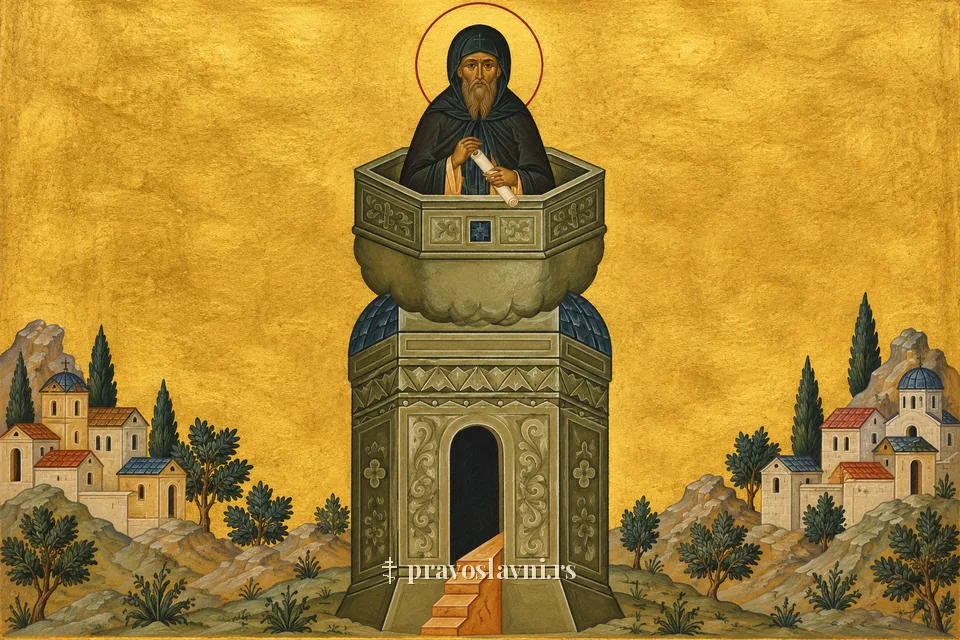
“Behold a wonder in my empire!” — so, as the Prologue records, Emperor Leo the Great used to speak of Venerable Daniel the Stylite. The stylite on his pillar did not flee either from the storms of the weather or from the assaults of men and demons, and everyone came to him for help and counsel, from the common people to emperors and patriarchs. The disciples who gathered around him he taught both by word and by his life, and God gave him the gift of miracles and of clairvoyance.
The road to the pillar began in Mesopotamia, in the village of Bethara near Samosata, where he was born as the only child of the Christians Elias and Martha; long barren, Martha, according to both sources, obtained him from God by prayer. At the age of twelve Daniel became a monk, and on a journey to Antioch with his abbot he received a blessing from St Simeon the Stylite, who foretold for him hard ascetic struggles. When his abbot died, he did not wish to govern the monastery. He set out for Palestine, but, as his Life says, an old monk directed him to Byzantium with the words: “God is not confined to any place.”
There he settled in an abandoned temple of idols, where demons used to kill travellers. For three nights they attacked him, but before the cross, the psalm and his endurance they were forced to retreat. According to his Life, from the patriarch, whom his prayer had cured, Daniel asked in return only forgiveness for his slanderers. Only after that did he go up onto the pillar.
His Life relates that he came down from the pillar only once: when the usurper Basiliscus supported the heresy against the Council of Chalcedon, at the request of Patriarch Acacius he went to defend Orthodoxy and foretold the fall of Basiliscus, which indeed came to pass.
He knew the day of his death beforehand and took leave of his disciples as a father. The Prologue and his Life record that before his repose a multitude of saints and angels appeared above the pillar. He lived for eighty years, and the Prologue states that he died in the year 489.
Daniel teaches us that a patient man of prayer, armed with the cross, is stronger than evil. He ascribed his strength to God, forgave his enemies and was faithful to the Church, even when for her sake he had to come down from the pillar.
Full Life
A Child of His Mother's Tears
Venerable Daniel was born in the village of Bethara near Samosata, in Mesopotamia. His parents were Christians, his father Elias and his mother Martha, who for a long time was unable to have children. According to his Life, Martha in her midnight prayers called upon the example of Sarah, Hannah and Elizabeth, and then she had a dream about a light. Her relatives saw in the dream the foretelling of a son of exceptional virtue. The child she thus received was her only one, and from his earliest years he was dedicated to God.
According to his Life, for five years he had no name. The name Daniel was given to him by the abbot of a certain monastery, after the prophet whose words he found in a book from the altar; yet, because of his age, he did not accept the child. At twelve years of age the boy secretly left home for a monastery some twenty stadia away. The abbot did not paint the monastic life in bright colours for him, but warned him how hard it is; the boy answered that just such a life, dedicated to Christ, was what he needed. He was received and tonsured a monk while still twelve years old.
A Blessing from the Pillar
With the abbot he travelled to Antioch. At Telanissos he climbed the ladder of St Simeon the Stylite and received his blessing. Simeon foretold hard ascetic labours for him, and his Life also records his words: “Be of good courage, my child, and let your heart be strengthened.” When his abbot died, Daniel did not wish to take over the governing of the monastery, but spent about forty days beside Simeon's pillar.
He then set out for Palestine, but there the Samaritans were at war with the Christians. His Life says that an old monk, resembling Simeon, directed him to Byzantium, saying: “God is not confined to any place.” Simeon confirmed this to him in a dream.
Three Nights with the Demons
Daniel settled in an abandoned temple of idols (the Prologue says: on the shore of the Black Sea, and his Life: at Anaplus), where demons used to strangle and kill travellers. Armed with the cross and the twenty-sixth psalm, he withstood three nights of attacks: the demons threw stones, shouted and, in the guise of giants, tried to strangle him or bury him. In the end they had to retreat before his endurance and prayer.
According to his Life, he lived shut up in the temple, and people began to come and to glorify God there. Envious clerics slandered him to Patriarch Anatolius, and then also accused him of sorcery; the Patriarch questioned him and embraced him. The only reward that Daniel asked of the Patriarch, whom his prayer had raised up from illness, was forgiveness for those who had slandered him. In this way, shut up in the temple, he spent nine years.
A Life between Heaven and Earth
His Life tells that in a vision he beheld Simeon on his pillar, calling him to come up. Simeon's disciple Sergius gave him Simeon's cowl, a white dove showed the place, and his friend Mark raised a pillar for him. He never again came down from the pillar until the end of his life, except once; neither storms nor wicked men nor demons drove him from it. Once, according to his Life, he stood through a tempest that lasted four days.
The disciples who came to the pillar he taught both by word and by his own life. God gave him the gift of many miracles and of clairvoyance. Help and counsel were sought from him alike by ordinary people and by those at the head of the empire and of the Church. “Behold, a wonder in my empire!” — that, according to the Prologue, is how Emperor Leo the Great spoke of him.
According to his Life, he foretold to the childless Emperor Leo a son within a year, and this was fulfilled. When heretics, through a hired harlot named Bassiana, tried to slander him, she fell under the power of a demon and confessed, and Daniel healed her and forgave her. Patriarch Gennadius ordained him a presbyter while standing on the ground, while Daniel remained on the pillar.
Coming Down for the Sake of the Church
When the usurper Basiliscus supported the Eutychian heresy against the Council of Chalcedon, Daniel, at the request of Patriarch Acacius and at a Divine voice, came down from the pillar. His Life says that he was carried on men's shoulders to defend the Church. He foretold the fall of Basiliscus; Basiliscus was overthrown, and Zeno, restored to the throne, paid honour to the saint.
Daniel knew the day of his death in advance and took leave of his disciples as a father. Before his death, according to the Prologue and his Life, a multitude of saints and angels appeared above the pillar; Patriarch Euphemius was then beside the pillar. He lived for eighty years (his Life says: eighty years and three months) and reposed in peace; the Prologue gives the year 489. His Life also records a sign after his death: until the burial a threefold sign of the cross, made of stars, stood above the pillar.
His life shows that neither demons nor men can do anything against one who endures and prays, armed with the cross. God does not leave His saints unglorified, and Daniel did not ascribe his strength to himself, but to God. He forgave his enemies and stood by the Orthodox Church, even though for that he had to come down from his pillar.