Red Letter day (great feast)noSunday — a festive day
Slavanone
Sunday26December 202713 December (according to the Julian calendar)‹›
Illustration
Saint of the day
Materice — Mothers' Day (second Sunday before Christmas)
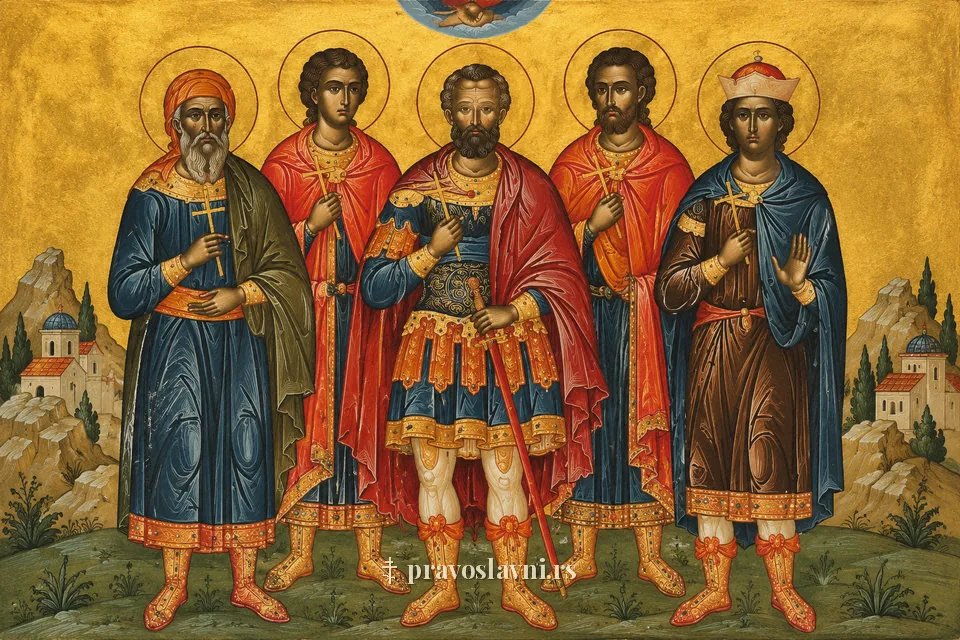
Holy Martyr Eustratius
What happenedMoved by the innocent suffering of the priest Auxentius, the military commander Eustratius came forward of his own accord before the governor Lysias and said that he was a Christian.
“We are hard-pressed on every side, yet not crushed; we are perplexed, but not in despair.”
— 2 Cor 4:8
About this day
Materice — Mothers' Day (second Sunday before Christmas)
Materice (Mothers' Day) is the folk name for the Sunday of the Holy Forefathers, the second Sunday before Christmas. It comes after Detinjci (Children's Day) and before Oci (Fathers' Day). For mothers and women this is the most important of the Christian feasts. On the last two Sundays before Christmas, on Materice and on Oci, the Church remembers the righteous of the Old Testament, to whom salvation was brought by faith in Christ, Whose birth was yet to come. Of the three family Sundays Materice is the most festive, so some families keep it even when they do not mark Detinjci and Oci.
By folk custom, early in the morning the children surprise their mother and tie her feet with a string, scarf or belt they have prepared, just as she tied them on Detinjci. The mother pretends not to know why she has been tied, the children wish her a happy feast, and the custom ends with a ransom and the giving of gifts. In the same way the children also tie other married women, among them the neighbours. For lunch or supper a festive family table is prepared.
These feasts strengthen harmony and respect in the family, between parents and children and between older and younger. In recent years Materice has also been marked in churches, especially in towns: by arrangement with the priest, the women of the parish prepare a programme in which the children recite and sing. In some places gifts are taken on that day to sick children in hospitals, especially on the children's wards, and in this way the feast gains its full Christian meaning.
Materice falls in that part of the Nativity Fast when Sunday is a day on which fish, oil and wine are allowed. For more on fasting on this day, see the guide “Fasting — simply explained”.
Eustratius lived in the time of the Emperors Diocletian and Maximian, when Christians were persecuted throughout the empire. He was a high-ranking military commander, devout and temperate. His Life says that he longed for martyrdom but was afraid of the tortures, and so he asked for a sign: he sent his belt to the church in Arauraka, and when the presbyter Auxentius took it up, Eustratius rejoiced.
Auxentius was the first to be arrested and tortured. After that Eustratius hid himself no longer: before the governor Lysias he confessed that he belonged to Christ, moved by the suffering of Auxentius, who was guilty of nothing. His Life records that Lysias took away his belt and his rank after twenty-seven years of service. They tortured him, and his Life says that God healed his wounds, so that those who witnessed it glorified the one God.
His courage stirred others as well. The Prologue records that his companion Eugene said to the judge: “Lysias, I too am a Christian”. In Arauraka they were joined by the poor man Mardarius, who left his wife and children in order to confess Christ together with them. The young soldier Orestes confessed the faith when a cross was noticed on him. All of them, one after another, gave their lives for Christ.
His Life tells that in Sebaste the governor Agricolaus tried to shake him by means of philosophy, and Eustratius answered him out of the very same writers. There Orestes died on a red-hot iron bed, and Eustratius was given Holy Communion in prison by night by Bishop Blaise, who was in hiding. His Life says that a voice was then heard from heaven: “Eustratius, you have fought splendidly.” Since he would not even pretend to offer sacrifice, he was condemned to be burnt. He entered the furnace praying to Christ, and the fire, according to his Life, harmed neither his body nor his hair. There he gave up his soul to God, on 13 December (according to the Julian calendar), and Blaise took his relics and carried out his last wish.
Constantinople, according to the Prologue, received their relics after some time. The five martyrs from Armenia showed that faith overcomes fear and pain, that God gives strength to His witnesses and that all earthly honour is nothing compared with the eternal crown.
Full Life
A Time of Fear
In the time of the Emperors Diocletian and Maximian, Christians were persecuted throughout the empire. The Life relates that Greater Armenia and Cappadocia were resisting the imperial decrees and threatening to break away. Diocletian took counsel with his nobles for three days, and then he replaced the governors there with two cruel men: to Lysias fell the defence of the frontiers, and to Agricolaus the administration. The Life says that Christians were moved from one province to another, so that they would end their lives in a foreign land, without burial among their own people.
Eustratius was a high-ranking military officer, a devout and temperate man. The Prologue calls him a commander, and the Life a tribune from Arabraca. The Life says that the persecution pained him deeply. He longed for martyrdom, but he was afraid of the tortures. And so he sought a sign: he sent a servant with his belt to the church in Arabraca. If the presbyter Auxentius took up the belt, he would go to martyrdom. Auxentius took it, and Eustratius rejoiced.
A Step Forward
Auxentius, as a priest, was arrested and tortured first. The innocent sufferings of Auxentius decided the matter: Eustratius confessed his faith before Lysias. The Life says that Lysias took away his belt and his rank, and he replied that he had served in the army for twenty-seven years and that he would not offer sacrifice to the idols. They tortured him for a long time, and he did not utter a sound. The Life also records a miracle: his wounds healed without a trace, and the onlookers glorified the one God.
Then Eugene too, the companion of Eustratius, stood before the judge. The Prologue remembers his words: “Lysias, I too am a Christian.” Both of them were put in chains and led onward.
When the procession was passing through Arabraca, the people gathered, but no one dared to come near. Poor Mardarius, a fellow countryman of Eustratius, caught sight of them from his roof; he left his house and family that very hour and joined the prisoners as a confessor of the faith. The Life records his cry: “I am a Christian! I am a servant of Christ!” His friend Mucator promised that he would take care of his family.
One after Another
Under torture both Eugene and Mardarius died, the latter while at prayer.
Then a new confessor came forward, the young soldier Orestes, tall and handsome. He was betrayed by the cross that he wore, and how this came about the sources tell differently: according to the Prologue, during target practice before Lysias, and according to the Life, at an inspection of weapons, where his golden cross was noticed. Orestes confessed Christ. The Life states that the soldiers of the garrison of Nicopolis also declared themselves soldiers of Christ, and so Lysias, fearing a conspiracy, sent Eustratius and Orestes to Agricolaus in Sebaste. Auxentius, according to the Life, was beheaded in a forest near Ororia. The presbyters of Arabraca took his body by night, and found his head in an oak tree, on a branch of which a raven was sitting, and they buried them together.
The Crown after the Flames
In Sebaste Agricolaus, as the Life relates, tried to shake him by means of law and philosophy, appealing to Plato, Aristotle, Homer and Hesiod. Eustratius answered him out of the same writers, and then spoke to him at length about the creation of the world, the fall of man, the Incarnation and the Resurrection. The torturers laid Orestes on a red-hot iron bed; frightened at the first moment, he prayed and breathed his last, and to this Eustratius said Amen.
In prison Eustratius wrote his will. He wished to be buried at Analikozora in Arabraca, together with Auxentius, Orestes, Mardarius and Eugene. He left his estate to the church, his movable property half to the poor and half to his sisters, and he set his slaves free. By night Bishop Blaise, who was in hiding at that time, came into the prison, having bribed the guards, and gave him Holy Communion. The Life says that a voice was then heard from heaven: “Eustratius, you have fought splendidly.” The voice called him to come for his crown, and those present fell to the ground in fear.
Agricolaus begged him in private at least to pretend that he was offering sacrifice. Eustratius refused and was condemned to be burned. He entered the furnace praying to the Lord Jesus Christ to receive his spirit, and the fire, as the Life records, harmed neither his body nor his hair. He met his end in the fiery furnace on 13 December according to the old calendar. Blaise took the relics of Eustratius and Orestes and carried out the will. The Prologue adds that a church was later built in Constantinople and named after them, the Holy Five Martyrs, and that their relics were translated to it.
The five martyrs set out one after another, and each drew strength from the courage of the other. Their example teaches that faith conquers fear and pain, that God strengthens His witnesses, and that earthly honour is nothing compared with the eternal crown.
Other saints of the day
Hieromartyr Gavrilo, Patriarch of Serbia
St Gavrilo was at first Metropolitan of Raška, and from 1648 to 1655 Patriarch of Serbia in Peć, as the successor of Patriarch Pajsije. He served under Turkish rule, at a time of heavy tribute and of pressure from Uniate missionaries. His Life says that in 1649 he took the tribute to Constantinople, and that he spent 1650 and 1651 travelling among the people, teaching them and defending them from the Unia. He travelled as far as Krušedol, Wallachia and Moldavia, and in the middle of 1654 he arrived in Moscow to ask for help, for many Serbian churches did not have even a metal chalice, but a wooden one. The Tsar and Patriarch Nikon received him kindly, and in 1655 he took part in the Council of Moscow. In that year, according to his Life, he sent his retinue home with the intention of staying in Russia, and in Peć Maksim became patriarch; when Gavrilo later changed his mind and returned, he was no longer able to regain the throne. The accusation of high treason made by the Turks was supplemented by a complaint from Jews whom he himself had converted: according to them, he was baptising Turks as well. He was taken to Bursa, before the sultan and the grand vizier. The vizier, according to his Life, found no guilt in him, but made his life, honours and riches conditional on his conversion to Islam. Gavrilo answered: “I am completely innocent of this accusation”, and said that he would die for Christ even many times over. He bore the torture patiently and joyfully, and he was put to death by hanging in the year 1659 in Bursa. Thus he placed faithfulness to Christ above life, honours and riches.