Saint of the day
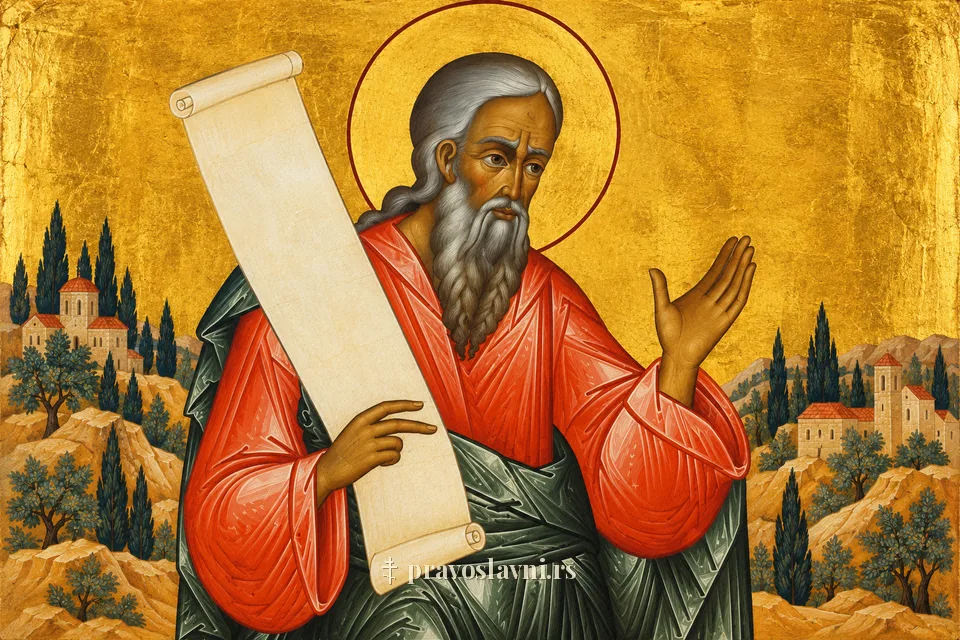
Holy Prophet Haggai
What happenedThe Prophet Haggai stirred up Zerubbabel and the high priest Joshua to rebuild the Temple of the Lord and foretold that the Saviour Himself would come to that new Temple.
Read the LifeOrthodox Calendar · 16 December according to the Julian calendar
Wednesday, 29 December 202716 December (according to the Julian calendar)What happenedThe Prophet Haggai stirred up Zerubbabel and the high priest Joshua to rebuild the Temple of the Lord and foretold that the Saviour Himself would come to that new Temple.
Read the Life
No meat, dairy products, eggs, fish or oil — food cooked in water.
This is a recommendation — for your own fast, consult your priest or spiritual father.More about the fast →
Today the Church keeps the commemoration of a saint · not a Red Letter day.
More about the feast →
“Be strong, all you people of the land,” says the LORD, “and work; for I am with you,” says the LORD of hosts.
— Hag 2:4Haggai, one of the Old Testament prophets, was descended from the tribe of Levi and was born in Babylon, in the time of the captivity. The Prologue and his Life say that he prophesied four hundred and seventy years before Christ.
As a young man he came to Jerusalem, where he encouraged Zerubbabel and the high priest Joshua, the son of Jehozadak, to take up the rebuilding of the temple. Holy Scripture preserves his prophecy that the new temple would surpass Solomon's in glory: ““The glory of this latter temple shall be greater than the former,” says the Lord of hosts” (Hag 2:9). According to the Prologue and his Life, he also foretold the coming of the Lord and Saviour into that temple.
Haggai still lived to see a part of the temple, the part which Zerubbabel raised. He died at a great age, and neither the year nor the place of his death has been recorded. His commemoration is on 29 December according to the new calendar, that is, 16 December according to the old.
Haggai teaches us that faithful work on the house of God, however modest it may be, carries the promise of a greater glory.
Haggai belonged to the tribe of Levi, and he came into the world in Babylon, where Israel was then living as a captive people. The Prologue and his Life set the time of his prophesying at four hundred and seventy years before Christ. He arrived in Jerusalem while still young.
There his word was addressed to the leaders of those who had returned: Zerubbabel and the high priest Joshua, the son of Jehozadak, heard from him the call for the house of the Lord to be raised anew.
The best-known prophecy of Haggai concerns precisely that new temple. Holy Scripture preserves his words: ““The glory of this latter temple shall be greater than the former,” says the Lord of hosts” (Hag 2:9). The prophet thus announced that the new house would surpass in glory the one that Solomon had built.
The Prologue and his Life find the reason for that glory in another of his prophecies: into that temple the Lord and Saviour Himself will come.
Before his death he still watched the part of the temple that Zerubbabel built as it rose. He reposed in deep old age, but neither the year nor the place of his death is known. His commemoration is on 29 December according to the new calendar, that is, 16 December according to the old calendar.
The Prophet Haggai reminds us that faithful work on the house of God, however modest the beginning may be, carries the promise of greater glory, for it is not stone that gives glory to the house, but the One who enters it.
St Theophano was a native of Constantinople, the daughter of Constantine and Anna, distinguished people who were related to several emperors. Her parents had no children for a long time, and so they prayed to the Theotokos in her church at Phorakia and were given a daughter. She was devout from childhood, and she began her schooling at the age of six. She was married to Leo, the son and heir of the Emperor Basil the Macedonian. The quarrel between father and son was stirred up by Bishop Theodore Santabarenos, who had the reputation of a sorcerer: he persuaded Leo to take with him on the hunt a knife hidden in his boot, and then informed Basil that his son was preparing his death. When the knife was found on Leo, Basil threw him and Theophano into a dark chamber under guard; their years of imprisonment — three according to the Prologue, more than three according to her Life — they filled with fasting and prayer. On the feast of the Prophet Elijah the court parrot kept repeating: “Alas, alas, Lord Leo!” — and so the nobles prevailed upon the emperor to set them free and restore Leo to honour. After Leo had inherited the throne, Theophano did not give up her ascetic life even as empress: beneath her splendid clothing she wore a rough hair shirt, she slept on a mat, and she ate the most modest food. With her money churches and monasteries were restored, the poor, widows and orphans received her help, and she lived with her servants as with a family. The last thing she did was to take leave of those close to her, whom she called to her side; the Prologue gives 892 as the year of her death. The church which the emperor intended for her was in the end given the name of All Saints: according to the Prologue, because the patriarch objected, and according to her Life, because she herself had forbidden it while she was still alive. Leo said that she should be honoured with all the saints, and from this, as the Prologue and her Life record, comes the feast of All Saints on the Sunday after Pentecost.