Saint of the day
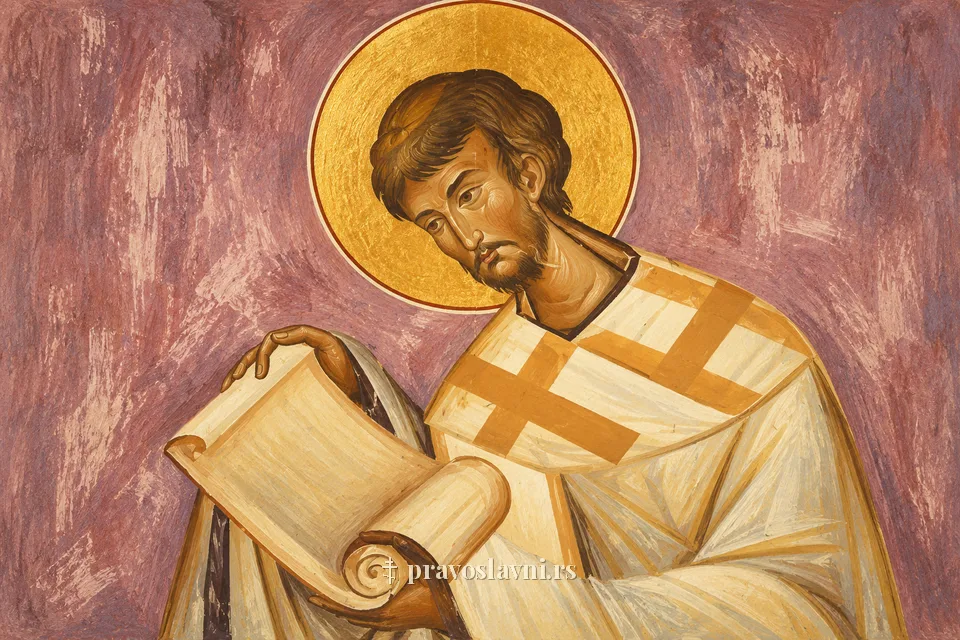
Hieromartyr Eleutherius
What happenedThe commander Felix came to arrest the young bishop Eleutherius, but as he listened to his preaching he knelt before him and received baptism.
Read the LifeOrthodox Calendar · 15 December according to the Julian calendar
Tuesday, 28 December 202715 December (according to the Julian calendar)What happenedThe commander Felix came to arrest the young bishop Eleutherius, but as he listened to his preaching he knelt before him and received baptism.
Read the Life
No meat, dairy products, eggs or fish — oil and wine are allowed.
This is a recommendation — for your own fast, consult your priest or spiritual father.More about the fast →
Today the Church keeps the commemoration of a saint · not a Red Letter day.
More about the feast →
“And you shall know the truth, and the truth shall make you free.”
— Jn 8:32The mother of St Eleutherius, Anthia, was instructed and baptised by the Apostle Paul himself; his father was a high imperial official, and the home in which he was born, in Rome, was distinguished and wealthy. He was brought up by the Bishop of Rome, to whom his mother, widowed early, entrusted him so that he might serve the Church. At the age of twenty he was already Bishop of Illyria, having been ordained a deacon as a fifteen-year-old and a priest as an eighteen-year-old.
Emperor Aelius Hadrian, a persecutor of Christians, wanted the young bishop to be brought to him in Rome, and he entrusted that task to the general Felix. Felix surrounded the church, but inside he came upon a sermon, which converted him, and so, instead of arresting the bishop, he fell on his knees before him. He received baptism from him on the way, beside a certain water.
Before the emperor Eleutherius refused to offer sacrifice to the idols. The Prologue and his Life record that he was tortured with fire in several ways, but each time God cooled the flame, and the martyr remained unharmed and sang praise. When the fire went out in the red-hot furnace, the people glorified the God of the Christians. The prefect Corebus, who had proposed that furnace, confessed Christ, rebuked the emperor and was beheaded.
His Life also tells of a dove that fed him in prison, of an angel who untied him from wild horses, and of wild beasts that were obedient to him in the wilderness. On his way back with the soldiers who had been sent for him, he taught them and baptised them — according to his Life, about five hundred people. Neither the lioness nor the lion in the circus harmed him, and the people cried out: “Great is the God of Eleutherius!”
In the end, by the emperor's order, he was beheaded. His mother was put to death over his body, which she joyfully embraced. The Christians buried them with honour. The year of his martyrdom, 120, and Valona as the place of his relics, where miracles occur to this day, are known from the Prologue.
St Eleutherius teaches us that God keeps His witnesses safe. The calm courage and prayer of one young bishop turned persecutors into believers.
Eleutherius was born in Rome, in a distinguished and wealthy house. His father bore the high imperial title of proconsul — according to his Life, as many as three times. His mother Anthia was a disciple of the Apostle Paul, from whom she also received baptism.
The Bishop of Rome took over the boy's upbringing when Anthia was left alone early in life, because his mother wished her only son to serve the Church. As to who that bishop was, the sources do not say the same thing: the Prologue mentions Anicetus, and his Life Anacletus. Before his twentieth year Eleutherius was already a deacon and a presbyter — he received the first rank at fifteen and the second at eighteen — and at twenty he became a bishop. Illyria was given into his care; the Prologue places his see in Valona, today in Albania.
The Emperor Aelius Hadrian, a fierce persecutor of Christians, wanted the young bishop in Rome. The task was given to the commander Felix, who set out to fetch him with soldiers and with the Emperor's threatening letter. He surrounded the church and went in, but he found the bishop preaching and stayed to listen, until he himself was converted and knelt before the man whom he was supposed to arrest.
He received baptism on the way, at the first water they came upon, and for this reason the sources compare him with the eunuch of Queen Candace. The Prologue stresses that he travelled towards Rome full of joy.
Before the Emperor, according to his Life, he first followed the example of Christ by keeping silent, and then he refused to sacrifice to the idols.
Tortures by fire followed, and in all of them, according to both sources, he remained unharmed. The iron bed over the fire did not burn him, for God cooled the flame, and the martyr sang praise to God. Nor did the cauldron of molten pitch and other burning substances do him any harm; rather, according to both sources, it was cool for him in it instead of hot. His Life also adds an attempt with an iron grid and oil, which likewise failed.
His Life says that the next torment, a red-hot furnace, was devised by the prefect of Rome, Corebus. Eleutherius, however, remained whole there too, for the fire went out and the nails broke, and so the onlookers glorified the God of the Christians; his Life preserves their cry: “Great is the God of the Christians, whom Eleutherius preaches!” Corebus, who had already been secretly moved by all this, received the blessing of Eleutherius and publicly confessed Christ, and to the Emperor, as his Life records, he said: “May your gold be your ruin.” And so he himself ended up in the furnace, which did not harm him either, although he spent a whole hour in it, and in the end he was beheaded.
Not even hunger in prison broke him, for, according to his Life, a dove fed him. When they tied him to untamed horses, an angel set him free and led him to a desolate mountain, where he lived among the wild beasts — lions and bears — which were obedient to him.
Hunters gave away where he was, and the beasts rushed upon the soldiers who came for him, until he restrained them. Then he returned with them of his own accord, and on the way he taught and baptised, so that, according to his Life, about five hundred souls were baptised on that journey. A lioness and a lion, let loose upon him in the circus, did not hurt him, and the people shouted: “Great is the God of Eleutherius!” Those who called him a sorcerer, according to his Life, were struck dumb.
At last Hadrian ordered that Eleutherius be beheaded with the sword. Nor was Anthia spared: they executed her over her son, whose body she was embracing and kissing with joy. The Christians of Illyricum and Rome, according to his Life, buried them both with honour. Valona, to which the relics were later translated, is, according to the Prologue, a place of many miracles to this day; the same source gives the year of his suffering, 120, and records that Felix also suffered for Christ.
The life of St Eleutherius shows that God protects those who bear witness to Him. The steadfastness of the young bishop converted the commander who came to fetch him, the prefect of the city, soldiers and whole crowds. Faithful courage and prayer can turn even a persecutor into a believer.
Venerable Paul came from a family related to Venerable Joannicius the Great, and his parents were Antiochus and Eudocia. The Prologue says that he was a native of Pergamum, and his Life that he was born in Elaea. According to his Life, he was left an orphan early on and tended swine, until his elder brother Basil, a monk on Mount Latros, brought him to the monastery. His teacher there was the elder Peter, from whom he learnt to pray and keep vigil without ceasing; according to his Life, he never slept lying down, and in order to stay awake he carried on himself at night a load of two stones. After Peter's death he would not agree to be abbot, but withdrew to a remote cave high up on Latros, where he fed on acorns and overcame the temptations of the demons. His Life states that by prayer he brought forth water, that an angel brought him food and that during prayer his fingers glowed with light. He healed the sick and the blind, and the disciples who settled below his cave founded a monastery. The Emperor Constantine Porphyrogenitus wrote to him asking for his prayers and counsel, and Samos, which Paul visited twice, received a lavra thanks to him, while three monasteries, destroyed in the attacks of the Hagarenes, came to life again. He foretold his own death, blessed the brethren and fell asleep in peace in old age — the Prologue says in the year 950. His life teaches that humility and flight from honours, together with unceasing prayer, bring a man closer to God than any authority.