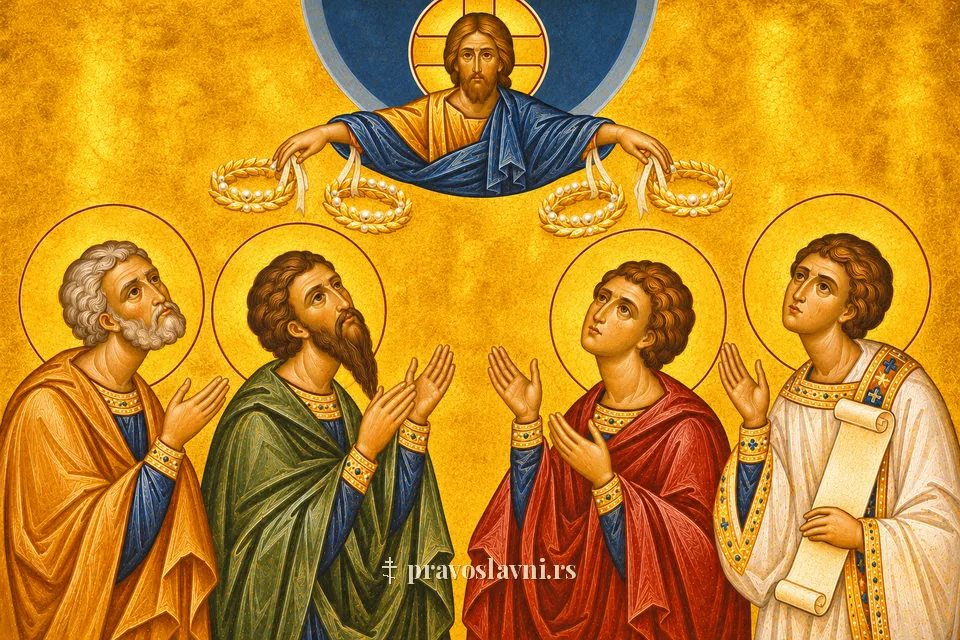
On this day the Church remembers martyrs from two regions, from Caesarea in Bithynia and from Egypt.
To Caesarea there came from Nicomedia the persecutor Cumbricius, and by flattery and threats he tried to force the Christians to bow down to idols. The distinguished and educated Leucius rebuked him publicly, and the Prologue preserves his words: “Why have you yourself made war upon your own soul, O Cumbricius?” For this he was beheaded outside the city, and he met his death with joy.
Thyrsus, following his example, himself condemned the idols. His Life says that Thyrsus was subjected to many tortures, but that God kept him safe: an angel healed his wounds in prison and opened the doors, the idols fell at his prayer, and the lions did not touch him. Those miracles converted the idols' priest Callinicus too, who, after confessing Christ, was beheaded. Not even a saw could cut through the chest in which they finally shut Thyrsus, and he reposed giving thanks to God for his sufferings. The Prologue adds that the Caesar Flavius later built a church in his honour near Constantinople and laid his relics in it.
In Egypt, under Diocletian, the Christians were persecuted by the governor Arian. The reader Apollonius, instead of going himself, sent the musician Philemon before the idols, for four gold coins and dressed in his own clothes. Philemon, however, confessed Christ there: he made the sign of the cross and, as his Life records, cried out: “I am a Christian! A servant of Christ, the living God!” The judge at first took this for a joke. According to the Prologue and the Life, Philemon received baptism in a miraculous manner in the midst of his torture. Apollonius admitted the deception, and both of them were beheaded.
The Life says that the governor, wounded in the eye while they were shooting arrows at Philemon, was healed at the martyr's grave and became a Christian. Later he refused to sacrifice to Apollo, and so Diocletian condemned him to death, and with him four guards, confessors of Christ.
These martyrs teach us that steadfast faith overcomes tortures and tyranny. Through miracles God shows His power and draws to Christ even persecutors, priests of idols and one entertainer.
Full Life
Leucius Goes to His Death as to a Wedding
The Prologue records that Thyrsus, Leucius and Callinicus were citizens of Caesarea in Bithynia. The Life says that Leucius was a respected and educated man of high birth, who grew up in Bithynia and was schooled in Caesarea. The persecutor Cumbricius arrived in Caesarea from Nicomedia (the Prologue calls him an emperor, the successor of Decius, and the Life a governor from the time of Decius), and by flattery and threats he drove people to bow down to the idols.
Leucius rebuked him publicly and called the idols lifeless. The Prologue preserves his words: “Why have you yourself made war on your own soul, O Cumbricius?” The persecutor, without any trial at all, had him beaten and then beheaded outside the city; Leucius went to his death with joy and thanksgiving to God.
Thyrsus, Whom the Tortures Did Not Break
Thyrsus, moved by the example of Leucius, himself condemned both the idols and the imperial decree before the persecutor. The Life says that he was subjected to heavy tortures but remained unharmed, and that God also restored his sight. According to both sources, an angel visited him in prison: his wounds were healed, and by night the doors opened before him. Then, according to the Life, he was baptised by the Bishop of Caesarea, who was hiding from the persecutors, and as he was returning to the prison, people saw light and angels around him.
The Life lists many more miracles. The statue of Apollo shattered with a thunderclap when Thyrsus prayed in that temple, and the Prologue says in general that many idols fell at his prayer. Nor did the cauldron of boiling water, into which they lowered him head first, do him any harm — it burst, and Thyrsus remained alive. In Apamea he foretold the end of the imperial envoy Silvanus and of Cumbricius; within four days both of them died of illness. Nor did the sea swallow him: Baudus, the new governor, had him thrown into the sea in a sack, but angels brought him back to dry land. Nor did the lions, before which they threw him after thirty days of hunger, touch him — the Life here recalls the Prophet Daniel — and many pagans then came to believe.
The Priest Who Took Off His Vestments
The miracles of Thyrsus, according to the Prologue and the Life, also brought to the faith a certain priest of the idols, Callinicus. When he prayed in the temple of Aesculapius, the statue collapsed; Callinicus then cast off the signs of his office — his hair, his beard and his priestly clothing — and confessed Christ, for which he was beheaded with the sword.
At last they wanted to saw Thyrsus in two together with the wooden chest in which they had shut him, but the wood would not yield beneath the saw. With his last words, which the Life preserves — “I thank You, O Lord Jesus Christ” — he gave thanks to God for his sufferings and reposed. The Prologue adds that the relics of Thyrsus were laid in a church which the caesar Flavius built for him near Constantinople at the end of the fourth century, and also that Thyrsus, in a vision, asked the Empress Pulcheria to lay the relics of the Forty Martyrs beside him.
A Musician in Another Man's Clothes
The second story of this day takes place in Egypt, under Diocletian, when the Thebaid was governed by Arianus, a persecutor of Christians; in Antinoe he had already had Asclas and Leonides put to death. The Life says that thirty-seven Christians refused to offer sacrifice to the idols, but that the reader Apollonius wavered. In order to save his life, he sent another man in his place: Philemon, a musician and a pagan, agreed, for four gold coins, to perform the sacrifice dressed in the clothes of Apollonius.
The outcome was the opposite of what had been agreed: instead of sacrificing, Philemon made the sign of the cross and said that he was a Christian; the Life records his cry: “I am a Christian! A servant of Christ, the living God!” Arianus at first saw this as a joke. Tortures did not help either, and Philemon, according to both sources, was baptised then and there — by water that fell from a cloud; the Life says that this was repeated three times and that his musical instruments were burned up in a flame from heaven. Apollonius admitted the deception and ended up in prison.
The Judge Who Received His Sight
Then, according to the Life, they hung Philemon on an olive tree and shot arrows at him, but it was the governor who suffered: an arrow injured his right eye. Philemon told him beforehand how he would be healed — by calling upon Christ and by earth from his grave. After the execution of Philemon and Apollonius, so it came to pass, and Arianus became a Christian; the Life records that he baptised his household and released thirty-six prisoners.
According to the Life, Diocletian summoned him to Alexandria, but Arianus would not offer sacrifice to Apollo. The Emperor condemned him to death, and with him there also suffered four guards — the eldest was called Theotychus — because they too confessed Christ. The Life adds that the bodies were thrown into the sea, but that they nevertheless reached the shore near Alexandria, where their servants buried them.
Steadfast faith overcomes tortures and tyranny. God shows His power through miracles and draws to Christ even persecutors, priests of the idols, and even a pagan entertainer.