Great and Holy TuesdayCommemoration: 27 April 2027
Commemoration in our calendar
Tuesday, 27 April 2027strict fast (no oil) · 14 April (according to the Julian calendar)
Tuesday27April 202714 April (according to the Julian calendar)
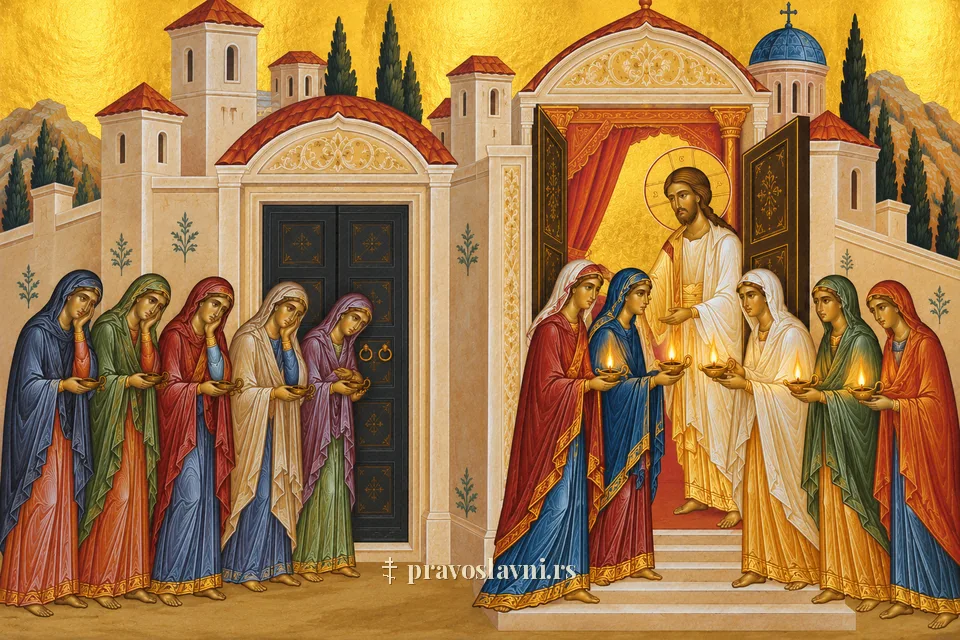
Illustration
Holy Week
Great and Holy Tuesday
What happenedThe Church dedicates Great and Holy Tuesday to the Lord's parables of the ten virgins and of the talents, which remind us of the Second Coming of Christ and the Last Judgement.
“Watch therefore, for you do not know when the master of the house is coming—in the evening, at midnight, at the crowing of the rooster, or in the morning—lest, coming suddenly, he find you sleeping.”
— Mk 13:35–36
About this day
The faithful spend the second day of Holy Week in fasting, as they did Great Lent, which precedes it. The service follows the same order as on the first day of the week: the Lenten Hours with the Typika, then the Liturgy of the Presanctified Gifts. At the Third, Sixth and Ninth Hours a passage from the Gospel is read; in nine such readings, over Monday, Tuesday and Wednesday, the whole of the Four Gospels is read, up to the words that now the Son of Man is glorified. Right up to Great and Holy Thursday “Thy Bridal Chamber” is sung. In the evening, and likewise on Wednesday, the faithful come to Great Compline, at which the priests serve in black vestments. The Gospel parables of this day call to watchfulness and readiness for the Lord's coming.
Life
Great and Holy Tuesday is the second day of Holy Week. On this day the Church remembers the Lord's parables of the ten virgins and of the talents, which remind us of the Second Coming of Christ and the Last Judgement. The Kingdom of Heaven is like ten virgins who took their lamps and went out to meet the bridegroom; five of them were wise, and five were foolish. The foolish ones took no oil with them, but the wise took oil in their vessels along with their lamps. The bridegroom was delayed and they all fell asleep, and at midnight a cry was heard that the bridegroom was coming. The lamps of the foolish ones were going out and they asked the wise to give them some oil, but the wise refused, so that there should not be too little for them as well. The foolish ones went away to buy oil; while they were gone the bridegroom came, those who were ready went in with him to the wedding, and the door was shut. When the others came later, he answered that he did not know them. The Lord concludes: “Watch therefore, for you know neither the day nor the hour in which the Son of Man is coming.”
In the parable of the talents a master, setting out on a journey, entrusts to his servants five talents, two, and one, to each according to his ability. The first two double what was entrusted to them and hear: “Well done, good and faithful servant; you were faithful over a few things, I will make you ruler over many things. Enter into the joy of your lord.” The third, out of fear, buries his talent in the ground; the master calls him wicked and lazy, takes the talent away from him and gives it to the one who has ten.
The services follow the same order as on Great and Holy Monday: the Lenten Hours with the reading of the four Gospels, and the Liturgy of the Presanctified Gifts. Great Compline is served, in black vestments. The oil in the lamps and the multiplied talents speak of watchfulness and of the faithful use of God's gifts, for no one knows the day or the hour.
Full Life
A day of watchfulness
Great and Holy Monday, Tuesday and Wednesday are the first days of Holy Week. On Great and Holy Tuesday the Church remembers the Lord's parables of the ten virgins and of the talents. Both parables call to mind the Second Coming of Christ and the Last Judgement, and how a person ought to be ready to meet the Lord.
The ten virgins
“Then the kingdom of heaven shall be likened to ten virgins who took their lamps and went out to meet the bridegroom.” (Mt 25:1) “Now five of them were wise, and five were foolish.” (Mt 25:2) The foolish took their lamps, but brought no oil with them, while the wise took oil in vessels along with their lamps. The bridegroom was delayed, and they all grew drowsy and fell asleep. At midnight a voice was heard: behold, the bridegroom, go out to meet him. The virgins trimmed their lamps, and the foolish asked the wise to give them some oil, because their lamps were going out. The wise refused, lest there should not be enough for them as well, and sent them off to buy some. While they were on their way to buy it, the bridegroom came; those who were ready went in with him to the wedding, and the door was shut. Later the other virgins came too and begged that it be opened to them, but he answered that he did not know them. The parable ends with the words: “Watch therefore, for you know neither the day nor the hour in which the Son of Man is coming.” (Mt 25:13)
The talents
A certain man, setting out on a journey, entrusted his goods to his servants: to one five talents, to another two, to a third one, to each according to his ability. The one with five talents traded and gained five more, and the one with two gained two more. The one who had received one dug a hole in the ground and hid his lord's money. After a long time the lord came back and asked for an account. To each faithful servant he said: “Well done, good and faithful servant; you were faithful over a few things, I will make you ruler over many things. Enter into the joy of your lord.” (Mt 25:21) The servant with the one talent said that he had known that his lord was a hard man, and so out of fear he had hidden the talent. The lord called him a wicked and lazy servant: he ought at least to have given the money to the bankers. The talent was taken from him and given to the one who had ten, for to everyone who has, more will be given, and the unprofitable servant was cast into the outer darkness.
The services
The order of the service of Great and Holy Tuesday is the same as on Monday. At each of the three Hours of the day one portion of the Gospel is read, so that over the first three days of the week the whole of the four Gospels is read through, and then the Liturgy of the Presanctified Gifts is served. Until Great and Holy Thursday “Thy Bridal Chamber” is sung. In the evening, as on Wednesday too, Great Compline is served, and the priests are in black vestments. The oil of the wise virgins and the multiplied talents speak of a life that is ready for the coming of the Lord.
Other saints of the day
St Martin the Confessor, Pope of Rome
“Even if the whole world were to accept this teaching, which is contrary to the true faith, I will not accept it” — with these words, as his Life records, Pope Martin of Rome rejected the Typos, the decree of the Emperor Constans II which favoured the Monothelite heretics. The Monothelites claimed that Christ has only one will, and the Life says that this teaching was also held by Paul, Patriarch of Constantinople.
Martin became pope on 5 July 649. He wrote to Paul and begged him to keep the Orthodox faith and to turn the Emperor away from his error, and because of this both the patriarch and the Emperor turned against him. He then called a council of one hundred and five bishops, which condemned both the heresy and the Typos; the Life says that this was in Rome, on the advice of Maximus the Confessor.
The Emperor sent a general to bring the pope in chains. The first general wanted to get rid of the pope secretly, by the hands of a soldier whom he had talked into it, in the middle of the church; but, as the Prologue and the Life record, the man with the hidden sword lost his sight, and by God's providence Martin remained alive. The second general, Theodore, came with slanders that the pope was plotting with the Saracens and that he did not honour the Most Pure Theotokos. Martin refuted it all, but he was arrested all the same.
For a long time he was held in prison in Constantinople, in hunger and distress. The Life records that he was tried on the basis of false testimony, that he could not defend himself properly because he did not know Greek, and that he wished to die for the faith. And Patriarch Paul, as he lay dying, confessed in tears that he had wronged Martin and asked the Emperor to spare him further torments.
Martin was exiled to Cherson, where he lived for about two years in hunger and hardship and reposed, according to the Prologue, in the year 655. According to the Life, he was buried in the Church of the Most Holy Theotokos of Blachernae outside Cherson, and at his tomb many of the sick received healing.
Martin's life teaches that it is better to suffer in the body than to renounce the true faith in Christ, God and Man, which the Fathers handed down.