Feast of the day
Apparition of the Precious Cross over Jerusalem
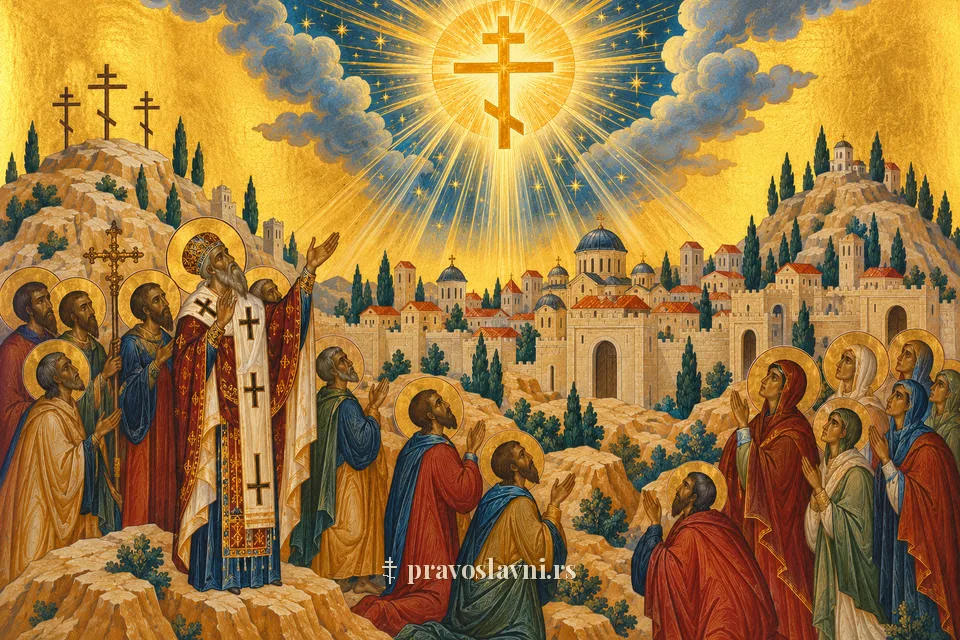
What happenedAt the third hour of the day a radiant Cross appeared over Jerusalem, stretching from Golgotha to the Mount of Olives, brighter than the sun.
Read the LifeOrthodox Calendar · 7 May according to the Julian calendar
Thursday, 20 May 20277 May (according to the Julian calendar)What happenedAt the third hour of the day a radiant Cross appeared over Jerusalem, stretching from Golgotha to the Mount of Olives, brighter than the sun.
Read the Life
You may eat meat, eggs, milk and dairy products, as well as any other food — but try to be moderate.
More about the fast →

“But God forbid that I should boast except in the cross of our Lord Jesus Christ, by whom the world has been crucified to me, and I to the world.”
— Gal 6:14On the seventh of May by the old calendar, in the year 357, the Cross appeared above Jerusalem at about the third hour of the day, stretching from Golgotha to beyond the Mount of Olives. The Prologue and the Life say that it was brighter than the sun and more beautiful than a rainbow.
The sign appeared while the son of Constantine the Great was reigning, a man inclined towards Arianism, which denied the divinity of the Son of God, and while Cyril was Patriarch in Jerusalem. No one stayed at work or at home. Fear and wonder took hold of all who looked up at the sky, whether they believed or not, and according to the Life a multitude gathered in the church and together glorified Jesus Christ, the only-begotten Son of God.
The sign brought many to Christ. According to the Prologue, many Arians abandoned their heresy and returned to Orthodoxy; the Life, referring to the historian Sozomen, says that many Jews and pagans were baptised. Cyril wrote to the Emperor about the sign, and the Life adds that he called on him to hold fast to Orthodoxy.
The Cross above Jerusalem is a reminder that the faith is proved not by human reasoning but by the power of God, before which even the opponents of the true faith were put to shame.
The Apparition of the Cross falls in the time when the empire was held by a son of Constantine the Great — the Prologue calls him Constans, the Life Constantius. The emperor leaned towards Arianism, the heresy which denied that the Son of God is God. At the head of the Church of Jerusalem at that time was Patriarch Cyril.
The Prologue and the Life give the year 357 and 7 May (according to the Julian calendar). At about the third hour of the day, by our reckoning about nine in the morning, the Cross appeared in the sky above the city. One end of it was over Golgotha, and the other above the Mount of Olives; the Life says that this is fifteen stadia and that the Cross was just as wide as it was long. Its light was stronger than the light of the sun, according to the Life beyond all telling, and it was more beautiful than a rainbow.
No one remained at his work or in his house. Both those who believed and those who did not gazed at the sky in fear and wonder. According to the Life, people of every age and rank streamed into the church, locals and strangers, Christians and non-Christians, and all together they glorified Jesus Christ, the only-begotten Son of God.
Many who had not believed until then came to Christ at that time. The Prologue makes special mention of the Arians, many of whom left their heresy and returned to Orthodoxy. The Life records that the sign put heretics and unbelievers to shame and showed that the faith is confirmed by the power of God, and it also appeals to the historian Sozomen, according to whom many Jews and pagans were baptised after the sign. It also recalls the Lord's words about the sign of the Son of Man in heaven (Mt 24:30).
Cyril wrote to the emperor about the sign and described what had happened; the Life says that in the same letter he called on him to remain faithful to Orthodoxy.
The sign over Jerusalem showed that the faith does not rest on what men are able to devise, but on the power of God. Before the Cross those who opposed the true faith were put to shame, and many came to believe at that time.